
 Medical Equipment
 Hospital Furniture
 Medical Disposables
 Rehabilitation
 Diagnostic & Labware
 Eyes & ENT
 Critical Care Equipment
 Urology
 Aesthetic & Dermatology Equipment
 Gastroenterology
 OT Equipment
By Devendra Sharma On 20-07-2026 at 4:55 pm
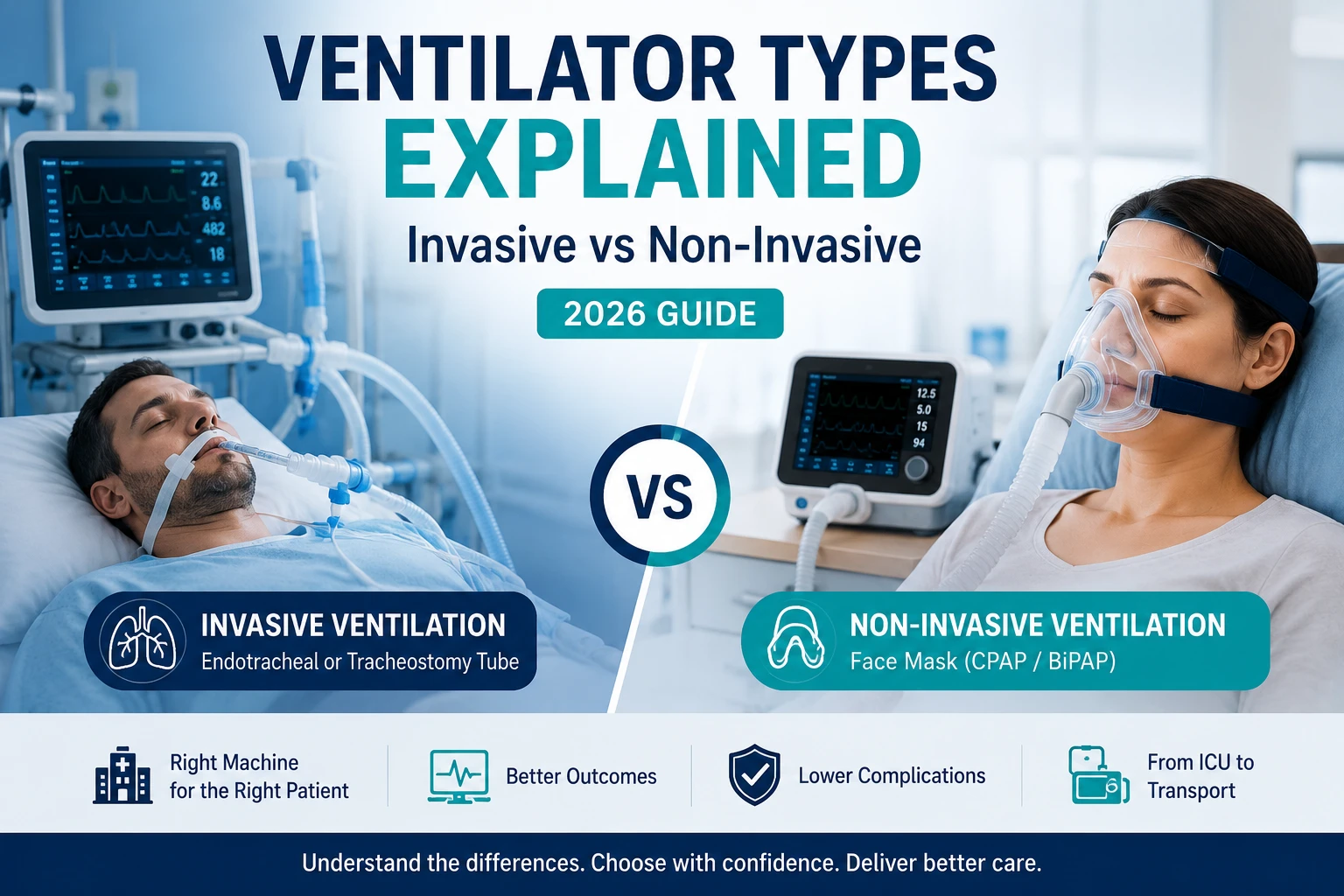
Ventilator Types Explained: Invasive vs Non-Invasive
Ask any respiratory therapist how many ventilator types their hospital stocks, and the answer is rarely one. A single ICU ventilator handles a sedated post-surgical patient just fine, but it's the wrong tool for a COPD patient who only needs help through a mask, or for a transfer down the hall to radiology. This guide breaks down invasive versus non-invasive ventilation, where each fits clinically, and what separates an ICU ventilator from a portable one, so hospital buyers and clinical teams can match the right machine to the right patient.
What is a ventilator and why do hospitals need different types?
A ventilator is a machine that moves air into and out of the lungs for patients who can't breathe adequately on their own, whether due to injury, illness, sedation, or surgery. No single ventilator design serves every one of these situations equally well, which is why hospitals stock several types rather than one universal machine.
Respiratory failure shows up differently depending on the patient and the setting. A patient in cardiac arrest needs full control of every breath through a tube. A patient with a COPD flare-up often just needs pressure support through a mask for a few hours.
Buying decisions follow that same logic. A central ICU needs full-featured critical care ventilators capable of every mode. A transfer team needs something compact enough to fit on a stretcher and run on battery power alone.
What is invasive ventilation and when is it used?
Invasive ventilation delivers air directly into the lungs through an endotracheal tube or a tracheostomy, bypassing the patient's natural airway completely. Doctors turn to it when a patient can't protect their airway, breathe on their own, or tolerate a mask, such as during general anesthesia, cardiac arrest, or severe respiratory failure.
Placing the tube, a process called intubation, requires a trained clinician and takes over breathing entirely once it's in place. The ventilator controls the rate, volume and pressure of every breath, which is exactly why it's the default choice for patients who are sedated or too unstable to breathe unsupported.
Because the tube sits directly in the airway, invasive ventilation also carries the highest infection risk of any ventilation type, a tradeoff clinicians weigh against the benefit of complete respiratory control.
What is non-invasive ventilation and when is it used?
Non-invasive ventilation, or NIV, supports breathing through a tightly fitted face mask or nasal mask instead of a tube placed in the airway, and it's the first option for patients who can still breathe on their own but need help doing it well. It's used most often for COPD flare-ups, cardiogenic pulmonary edema, sleep apnea and some post-extubation patients.
NIV keeps the patient talking, coughing and swallowing normally, which is a real clinical advantage over a tube down the airway. That's part of why the evidence behind it looks as strong as it does.
A Cochrane review covering COPD exacerbations found NIV reduced mortality by roughly half, cut the odds of needing intubation by about 60 percent, and lowered treatment failure by just over half compared with standard oxygen therapy alone.
Numbers like that are a big part of why NIV has become the default first attempt for suitable patients before anyone reaches for a tube.
What are the main differences between invasive and non-invasive ventilation?
Invasive ventilation intubates the airway and takes over breathing completely, while non-invasive ventilation supports breathing through a mask without touching the airway at all. The choice comes down to how much respiratory function the patient has left and how much control the clinical team needs over each breath.
Neither type is universally "better." A hospital that only stocks one is either under-equipped for its sickest patients or over-treating everyone else with more machine than they need.
What is the difference between CPAP and BiPAP?
CPAP delivers one constant level of air pressure throughout both inhaling and exhaling, while BiPAP switches between a higher pressure on the inhale and a lower one on the exhale. That difference makes BiPAP the more commonly recommended non-invasive mode for COPD exacerbations, since it eases the effort of breathing out as well as in.
CPAP is the more familiar of the two to most people, since it's also the standard treatment for obstructive sleep apnea at home. It's simple, well tolerated over the long term, and doesn't require the machine to track the patient's breathing cycle as closely as BiPAP does.
BiPAP costs more and has more settings to manage, but it does more work for the patient during exhalation, which matters when someone is already struggling to breathe out against narrowed airways.
What features define an ICU or critical care ventilator?
A critical care ventilator supports every ventilation mode a hospital might need, volume-controlled, pressure-controlled, SIMV and more, along with built-in humidification, detailed alarms, and enough battery backup to survive a power interruption without missing a breath. These machines are built for the sickest patients in the hospital, not for portability.
Expect full monitoring integration, self-testing on startup, and compatibility with both adult and pediatric circuits on higher-end models. None of that comes cheap, and none of it is optional in a central ICU running ventilated patients around the clock. Hospitals sourcing these units usually shortlist a few models from a ventilator machine supplier and compare mode coverage against their actual patient mix before committing.
What a critical care ventilator gives up is portability. These machines are large, rely on mains power as their primary source, and aren't designed to travel with the patient outside the unit.
When is a portable or transport ventilator used instead?
A portable or transport ventilator is a compact, battery-powered machine used to move ventilated patients between departments, during ambulance transfers, or in home and field settings where a full ICU ventilator isn't practical. It supports fewer modes than a critical care unit but keeps working where a mains-powered machine can't.
Weight and battery life matter more here than mode variety. A transport ventilator under seven kilograms with several hours of battery runtime covers most intra-hospital transfers without needing a spare cylinder or backup unit along for the ride.
Home ventilation is the other growing use case. Patients with chronic respiratory conditions increasingly transition from an ICU ventilator to a portable home unit once they're stable enough, a shift that takes careful planning around settings and alarms rather than just handing over a smaller machine.
What ventilator modes should hospital buyers understand before purchasing?
Volume-controlled ventilation delivers a fixed air volume with every breath, pressure-controlled ventilation delivers a fixed pressure and lets volume vary, and SIMV lets the patient trigger some of their own breaths between machine-delivered ones. Most modern ventilators combine several of these modes so clinicians can switch as a patient's condition changes.
Pressure support ventilation, a mode where the machine boosts each breath the patient initiates rather than fully controlling it, is the most commonly used non-invasive mode because it feels more natural to a patient who's still doing some of the work themselves.
None of this needs to be memorized by a procurement team, but knowing the terms helps when a dealer's spec sheet lists modes with no explanation of what they actually do for a patient.
What are the risks associated with each ventilation type?
Invasive ventilation carries a real risk of ventilator-associated pneumonia and long-term dependence on the machine, since intubation bypasses the body's natural airway defenses. Non-invasive ventilation is lower-risk but not risk-free, with mask discomfort, skin breakdown, and aspiration if the patient vomits under pressure being the more common complications.
Ventilator-associated pneumonia is the complication clinical teams watch hardest for with invasive ventilation, since the tube gives bacteria a more direct route into the lungs than a patient's own airway would allow.
NIV's risks are more about tolerance than infection. A poorly fitted mask causes pressure sores within hours, and patients who can't manage their own secretions or airway are generally poor candidates for it regardless of how mild their case looks otherwise.
How do you choose the right ventilator type for a hospital or ICU?
Match the ventilator to the patient population you actually treat, not to the most advanced machine on a supplier's brochure. A general hospital ICU needs a strong base of critical care ventilators plus a handful of portable units for transfers, while a hospital running a heavy home-care or step-down program needs BiPAP and CPAP units in far greater numbers.
This is where working with a supplier who stocks the full range, rather than just one category, saves a lot of back-and-forth. HOSPkart, a B2B medical equipment marketplace, lists critical care ventilators, portable ventilators and CPAP/BiPAP machines from verified manufacturers on one platform, so a hospital can compare specifications across all three categories instead of chasing separate dealers for each ventilation type. That matters most when a hospital is scaling an ICU and a step-down unit at the same time, since the equipment mix rarely falls neatly into one supplier's specialty.
Whatever you land on, ask for the same three things regardless of ventilator type: documented CDSCO registration, a clear spare-parts and AMC commitment, and hands-on training for the clinical staff who'll actually run the machine day to day.
Frequently asked questions
What is the main difference between invasive and non-invasive ventilation?
Invasive ventilation delivers air through a tube placed in the airway and takes over breathing completely, while non-invasive ventilation supports breathing through a mask without entering the airway.
Is BiPAP the same as a ventilator?
BiPAP is a form of non-invasive ventilation, so it is a type of ventilator, just one that works through a mask rather than a tube.
When does a patient need invasive ventilation instead of non-invasive?
Patients need invasive ventilation when they can't protect their airway, breathe on their own, or tolerate a mask, such as during cardiac arrest, deep sedation, or severe respiratory failure.
Can a patient move from an ICU ventilator to a portable ventilator?
Yes, patients who are stable but need ongoing respiratory support often transition from a full ICU ventilator to a portable or home ventilator with careful settings adjustment.
What is the biggest risk of long-term invasive ventilation?
The most common serious risk is ventilator-associated pneumonia, along with prolonged dependence on the machine the longer a patient stays intubated.

Author
Devendra Sharma
Related posts




15-4-2026
Top 20 Lab Equipment for Diagnostic Labs