 Medical Equipment
 Hospital Furniture
 Medical Disposables
 Rehabilitation
 Diagnostic & Labware
 Eyes & ENT
 Critical Care Equipment
 Urology
 Aesthetic & Dermatology Equipment
 Gastroenterology
 OT Equipment
By Devendra Sharma On 14-07-2026 at 6:05 pm
OT Equipment Supplier in Jaipur: Complete Checklist 2026
Jaipur's hospital sector has grown fast over the past few years, with new multi-specialty centres opening across Malviya Nagar, Vaishali Nagar, and the Tonk Road corridor, alongside older hospitals adding a second or third operation theatre to keep up with surgical volume. An OT build is one of the most equipment-heavy parts of a hospital project, and it's also where a rushed vendor decision costs the most, since an OT table or anesthesia workstation isn't something you swap out easily once it's installed.
This checklist walks through what belongs in a new or expanding OT, what things typically cost in the Jaipur market, and how to evaluate an OT equipment supplier in Jaipur before signing a purchase order.
What equipment do you need for a new operation theatre in Jaipur?
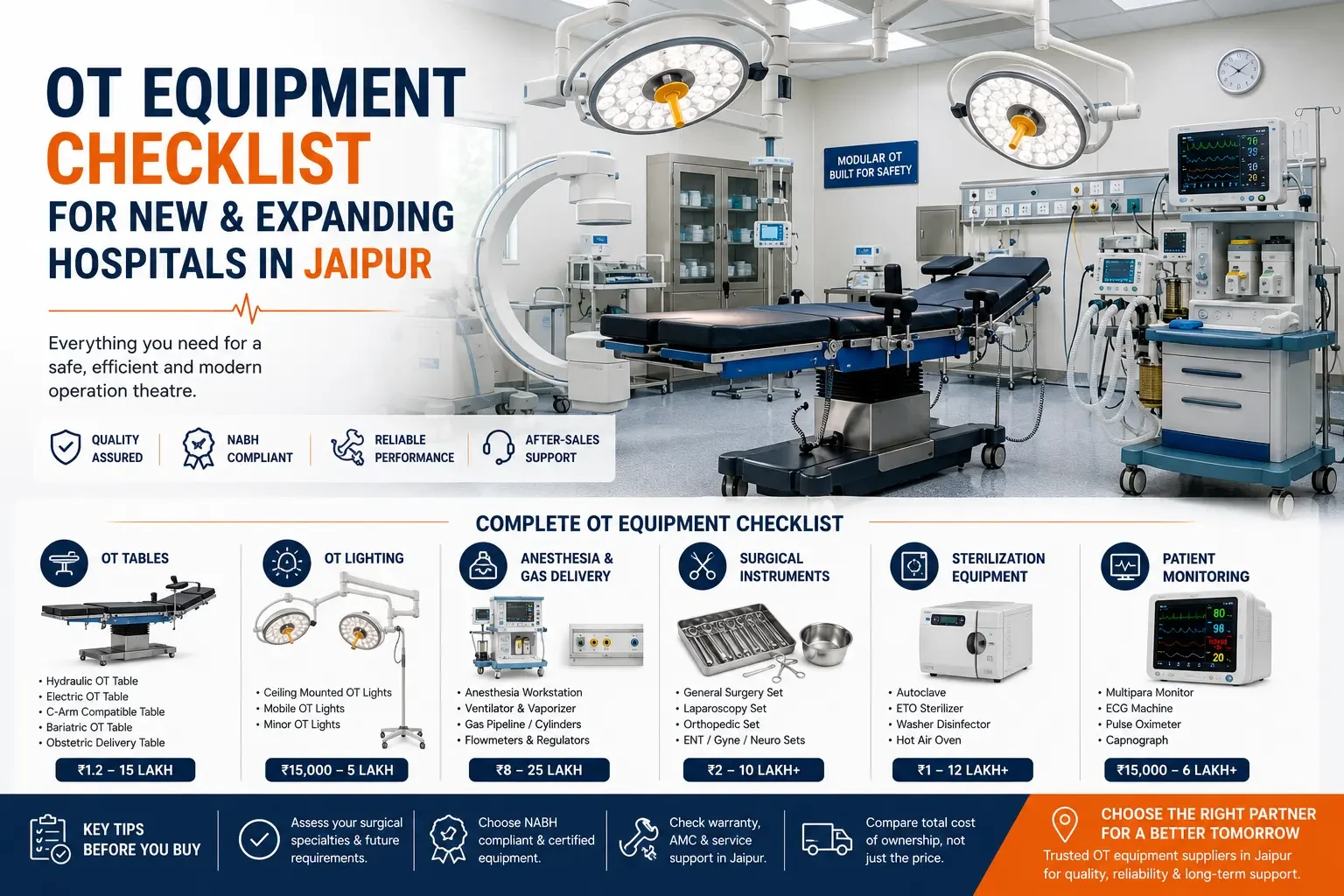
A functioning OT needs six equipment categories at minimum: the OT table, OT lighting, anesthesia and gas delivery systems, surgical instruments, sterilization equipment, and patient monitoring. Specialty surgeries add specific equipment on top of this base, but no OT opens without these six covered.
The OT table and lighting form the physical core of the room and are usually finalized first, since room dimensions, ceiling mounts, and electrical layout depend on which table and light models you choose. Anesthesia and monitoring equipment come next, followed by surgical instrument sets, which vary heavily by specialty.
Sterilization equipment is often treated as a separate purchase handled by the central sterile supply department (CSSD) rather than the OT budget directly, but for a single-OT setup or a small nursing home, it's common to fold autoclave and instrument sterilization into the same procurement round.
What does an OT table cost in Jaipur?
OT table prices in Jaipur typically range from ₹1.2 lakh for a basic hydraulic table to ₹8-15 lakh for a fully electric, multi-position table with C-arm compatibility. The right choice depends on surgical specialty mix, not just budget.
A hydraulic OT table is the standard entry point for general surgery, gynecology, and minor procedures, priced around ₹1.2-3 lakh. It covers basic Trendelenburg, lateral tilt, and height adjustment through a manual or foot-pump mechanism.
A fully electric OT table adds motorized positioning and memory presets, which matters for hospitals running high surgical volume where turnover time between cases affects OT utilization. These run ₹4-8 lakh depending on load capacity and positioning range.
C-arm compatible tables are necessary for orthopedic and neuro cases where intraoperative imaging is routine, and the radiolucent tabletop that allows this adds ₹1-3 lakh over a comparable non-compatible model. A hospital planning to do trauma or spine surgery should budget for this from the start rather than retrofitting later.
Bariatric operating tables, rated for higher patient weight capacity, cost roughly the same as a standard electric table but are worth stocking separately if your hospital sees consistent bariatric surgical volume, since running every case on a standard-capacity table is both a safety and liability concern.
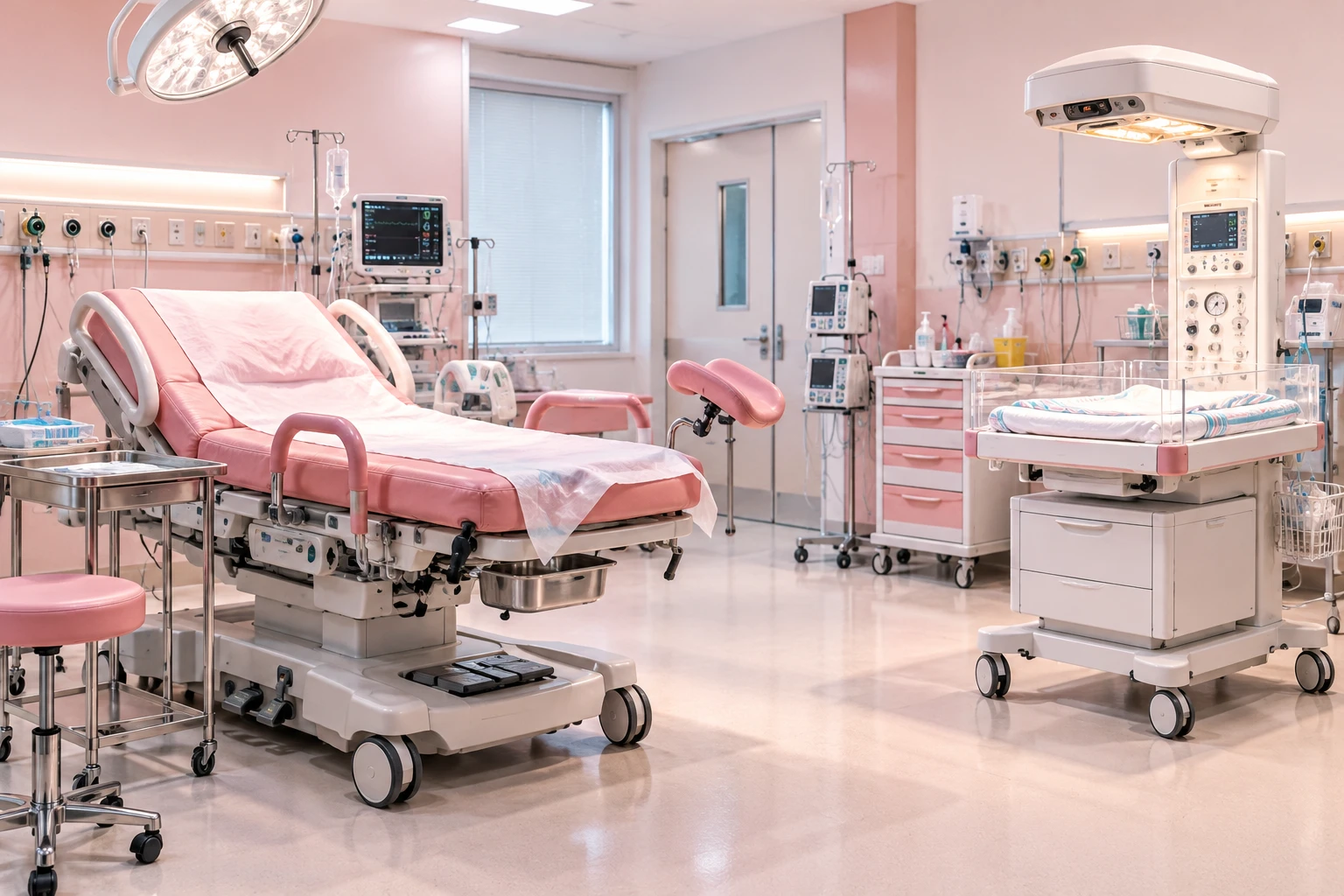
Specialty tables for ENT, dental, and ophthalmic procedures are generally cheaper, ₹80,000-2 lakh, since they don't need the same positioning range as a general surgical table. Hospitals with a labor and delivery unit adjoining the OT floor should also budget separately for obstetric delivery tables and beds, which aren't interchangeable with a general surgical table despite the surface-level similarity.
What OT lighting setup do you need?
An OT needs at minimum one primary ceiling-mounted surgical light over the table, with most hospitals adding a second satellite light for better shadow control during deep or angled procedures. Lighting is priced by lux output, color rendering index, and mounting type rather than by brand alone.
Ceiling-mounted OT lights are the standard for a permanent OT and run ₹1.5-5 lakh per unit depending on LED configuration and arm reach. A dual-head ceiling mount, common in general surgery rooms, sits toward the higher end of that range.
Mobile OT lights are worth having even in a hospital with fixed ceiling lights, since they cover minor procedure rooms, backup during ceiling light servicing, and any space that wasn't originally built as an OT. These cost ₹40,000-1.2 lakh.
Minor OT and examination lighting, used for procedure rooms rather than the main theatre, is considerably cheaper at ₹15,000-50,000, and it's a category new hospitals sometimes forget to budget separately from main OT lighting.
What anesthesia and gas delivery equipment is required?
An OT needs an anesthesia workstation with integrated vaporizer, a central or cylinder-based gas supply with flowmeters, and a gas outlet panel wired to the room, at a combined cost of roughly ₹8-25 lakh for a full setup depending on whether gas is piped centrally or cylinder-based.
A modern anesthesia machine with integrated ventilator, monitoring, and vaporizer typically costs ₹6-18 lakh, and this is one category where buying a mid-range unit from a verified manufacturer generally beats stretching for a premium brand outside budget, since service availability in Jaipur matters more day to day than marginal feature differences.
Piped medical gas, running oxygen and nitrous oxide from a central manifold room to each OT, is a significant civil and mechanical investment, often ₹5-10 lakh for a single-OT setup, but it removes cylinder-handling risk from the theatre itself and is generally required for NABH accreditation. Smaller nursing homes sometimes start with cylinder-based supply and pipe gas in during a later expansion.
What surgical instruments should be on your OT equipment checklist?
A base surgical instrument set covers hemostatic forceps and clamps, surgical scissors, scalpel handles and blades, retractors, and sterilization forceps, with specialty additions layered on by surgical department. Instrument sets are typically bought per specialty rather than as one generic kit.
General surgery needs a standard set of surgical scissors, hemostatic forceps and clamps, and handles, holders, and speculums, typically costing ₹1.5-4 lakh for a complete multi-tray set depending on stainless steel grade and instrument count.
Orthopedic and trauma OTs need cranial and bone drills, locking plate systems, and fixation hardware, which run considerably higher, often ₹5-15 lakh for a starter inventory across common fracture types, since implant stock has to be maintained across multiple sizes.
Cautery machines and laryngoscopes are cross-specialty essentials that belong on every OT checklist regardless of surgical focus, priced at ₹25,000-1.5 lakh and ₹8,000-40,000 respectively depending on whether the laryngoscope is conventional or video-assisted.
A common early-stage mistake is under-stocking instrument trays, assuming one set covers a full day's caseload. Most OTs running more than 2-3 procedures a day need at least two complete instrument sets in rotation to account for sterilization turnaround time.
What sterilization and infection control equipment do you need?
An OT needs autoclave sterilization for reusable instruments, either a standalone unit in the OT complex or a shared CSSD facility, plus laminar air flow for the OT itself to maintain positive-pressure, filtered air during procedures.
An autoclave sized for OT-level instrument turnover costs ₹2-8 lakh depending on chamber size and cycle speed, and cycle time matters more here than in a general lab, since slow sterilization directly limits how many cases an OT can run per day.
Laminar air flow units, which maintain filtered, positive-pressure airflow in the OT to reduce airborne contamination, cost ₹3-8 lakh and are a standard NABH and state licensing requirement for any operating theatre, not an optional upgrade.
What monitoring and critical care equipment belongs in the OT?
Every OT needs a multipara patient monitor with continuous ECG, SpO2, capnography, and non-invasive blood pressure, along with immediate access to a defibrillator and, for most general surgical OTs, a ventilator integrated into the anesthesia workstation.
A multipara patient monitor configured for OT use, with capnography and gas analysis, typically runs ₹2-5 lakh, higher than a standard ward monitor because of the added anesthesia-specific parameters.
A defibrillator is a fixed requirement for OT licensing in Rajasthan, and budgeting one per OT rather than one shared across a small hospital's entire surgical floor avoids a dangerous delay during a cardiac event mid-procedure.
How much does it cost to set up an OT in Jaipur?
Setting up a single general-surgery OT in Jaipur typically costs ₹35-60 lakh including table, lighting, anesthesia workstation, instruments, sterilization, and monitoring, while a specialty OT built for orthopedics, neurosurgery, or cardiac cases usually runs ₹70 lakh to over ₹1.5 crore.
| Component | General surgery OT | Specialty OT (ortho/neuro) |
|---|---|---|
| OT table | ₹3-8 lakh | ₹6-15 lakh |
| OT lighting | ₹2-5 lakh | ₹3-7 lakh |
| Anesthesia workstation + gas | ₹8-15 lakh | ₹10-20 lakh |
| Surgical instruments | ₹3-6 lakh | ₹8-20 lakh |
| Sterilization + laminar flow | ₹5-10 lakh | ₹5-12 lakh |
| Monitoring + defibrillator | ₹3-6 lakh | ₹4-8 lakh |
| Civil work, flooring, HVAC | ₹10-20 lakh | ₹15-30 lakh |
These figures are directional planning estimates, not fixed quotations, and actual cost depends heavily on whether equipment is new or refurbished, and on civil work complexity for the room itself.
What regulatory approvals do you need for an OT in Rajasthan?
An OT in Rajasthan needs clinical establishment registration under the Rajasthan Clinical Establishments Act, biomedical waste authorization from the Rajasthan State Pollution Control Board, fire safety NOC, and, for most hospitals seeking insurance empanelment, NABH pre-accreditation entry-level certification.
Clinical establishment registration is tied to physical infrastructure specs, including OT room dimensions, air handling standards, and equipment inventory, so it's worth reviewing current requirements with the district health authority before finalizing equipment specifications rather than after installation.
NABH entry-level certification isn't legally mandatory to operate, but most insurance TPAs and corporate empanelment lists in Jaipur now expect it, and the equipment documentation NABH auditors check, calibration certificates, AMC contracts, and biomedical maintenance logs, is far easier to assemble if it's tracked from the day equipment is installed.
How do you choose a reliable OT equipment supplier in Jaipur?
A reliable OT equipment supplier in Jaipur should have a verifiable GST registration, documented after-sales service presence in the city rather than a distant regional office, manufacturer-backed warranty on capital equipment, and a track record with other Jaipur hospitals you can call and ask about.
Local service turnaround is the single biggest factor that separates a good OT equipment dealer from a risky one. An anesthesia workstation or OT table that goes down and needs a technician to travel from Delhi or Mumbai can shut a theatre for days, while a Jaipur-based service team can usually reach a hospital within hours.
This is also where sourcing through a verified marketplace helps rather than working through unverified classifieds or cold-call vendors. HOSPkart, which is headquartered in Jaipur at the Bhamashah Techno Hub, runs a verified manufacturing network for hospital and OT equipment, so hospitals in the city can source OT tables, OT lights, and surgical instruments from sellers who've already been checked for GST compliance and service capability, without treating every quotation as a separate trust exercise.
Ask any prospective OT equipment dealer in Jaipur for three references from hospitals of comparable size, and actually call them. A dealer confident in their service record will offer this without hesitation, while one that hedges or offers only manufacturer contacts instead of hospital references is worth a second look.
Frequently asked questions
How long does it take to set up a new OT in Jaipur from order to first surgery? Most single-OT builds take 10-16 weeks from finalized equipment orders, accounting for civil work, installation, calibration, and regulatory inspection.
Is it better to buy a new or refurbished anesthesia machine? New is generally safer for anesthesia workstations specifically, since these are life-critical systems where a documented full service history matters more than the 30-40% savings refurbished units typically offer.
Do I need NABH certification to legally run an OT in Jaipur? No, NABH isn't a legal requirement, but clinical establishment registration under Rajasthan's Clinical Establishments Act is, and NABH is increasingly expected for insurance empanelment.
What's the minimum OT table type for a general hospital? A hydraulic general-surgery table covers most routine procedures; a hospital doing orthopedic, trauma, or C-arm-dependent surgery should budget for a C-arm compatible table from the start.
An OT build touches more line items than almost any other part of a hospital project, and getting the equipment list wrong shows up fast in delayed surgeries and downtime. You can browse OT tables, OT lighting, and the full OT and surgical equipment range from verified Jaipur-based and pan-India suppliers on HOSPkart to compare specs and pricing in one place.

Author
Devendra Sharma
Related posts


15-4-2026
Top 20 Lab Equipment for Diagnostic Labs