 Medical Equipment
 Hospital Furniture
 Medical Disposables
 Rehabilitation
 Diagnostic & Labware
 Eyes & ENT
 Critical Care Equipment
 Urology
 Aesthetic & Dermatology Equipment
 Gastroenterology
 OT Equipment
By Devendra Sharma On 14-07-2026 at 4:55 pm
Diagnostic Lab Equipment List for India (2026 Setup Guide)
Opening a diagnostic centre is one part medicine, one part logistics, and one part spreadsheet. Most first-time owners underestimate the second and third parts. A missing centrifuge or an unbudgeted UPS backup can delay a launch by weeks, and every week of delay is rent paid on an empty building.
This guide walks through the full diagnostic lab equipment list by department, rough costs in INR, the approvals you need before you buy anything, and how to avoid the fake-seller trap that catches a lot of first-time buyers.
What equipment do you need to open a diagnostic lab in India?
A functioning diagnostic lab needs equipment across six areas: biochemistry, hematology, microbiology, clinical pathology, imaging, and point-of-care testing. Most centres also need cold storage, sample collection stations, and IT infrastructure that rarely makes it onto a first draft of the budget.
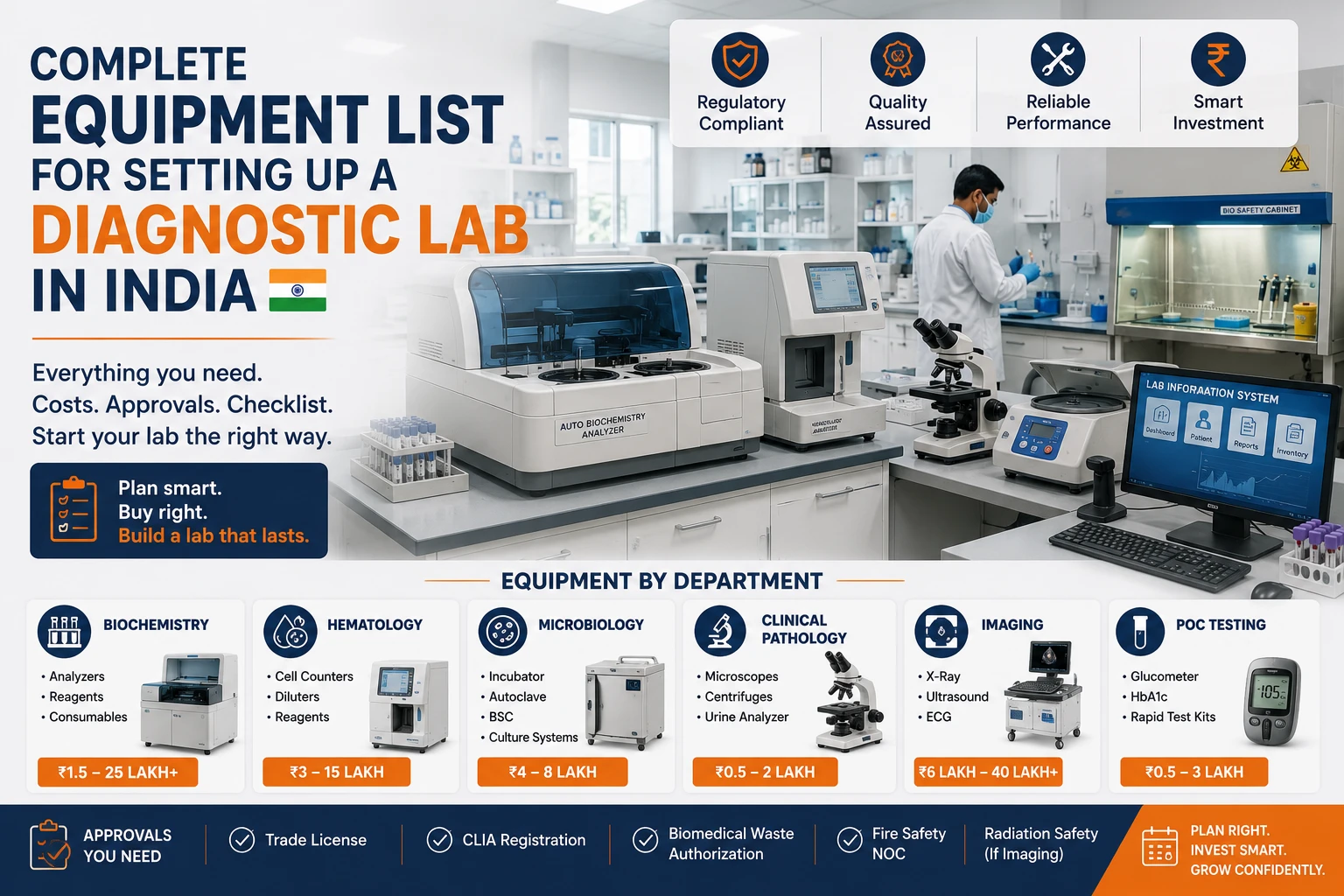
Biochemistry is usually the backbone of a general diagnostic lab, since liver function, kidney function, and lipid profile tests drive a large share of daily footfall. The core machine here is a semi-automated or fully automated biochemistry analyzer, priced from roughly ₹1.5 lakh for a semi-auto unit to ₹15-25 lakh for a high-throughput automated system.
Hematology covers the complete blood count (CBC), which is arguably the single most-ordered test in Indian diagnostics. A 3-part differential cell counter starts around ₹3-5 lakh, while 5-part analyzers, which give more granular white cell data, run ₹8-15 lakh.
Microbiology setups need an incubator, autoclave, biosafety cabinet, and a culture and sensitivity workflow. Even a modest microbiology bay adds ₹4-8 lakh to the budget, and it's a section labs sometimes skip early and regret later when doctors ask for culture reports.
Clinical pathology is comparatively cheap. Binocular microscopes, urine analyzers, and centrifuges together often cost under ₹2 lakh, but they're used constantly, so quality matters more than the low price tag suggests. Browsing these side by side on a single diagnostic and labware catalog like HOSPkart makes it easier to compare specs and pricing across brands instead of chasing separate distributors for each machine.
What does a basic biochemistry and hematology setup cost?
A starter biochemistry and hematology combination for a small-to-mid diagnostic centre typically costs ₹8-20 lakh, covering one automated biochemistry analyzer, one 3-part hematology analyzer, and supporting glassware and reagents for the first three months.
This range assumes new equipment from an authorized dealer. Refurbished analyzers can cut this by 30-40%, but only make sense when the seller offers a service contract and can show valid calibration records. A biochemistry analyzer that hasn't been serviced in over a year is a liability, not a discount.
Reagent cost is the part most new owners forget to model. A mid-volume biochemistry analyzer running 100-150 samples a day can burn through ₹40,000-60,000 in reagents monthly, and that recurring cost matters more to your first-year cash flow than the upfront machine price.
What imaging equipment do you need and how much does it cost?
Imaging is optional for a pure pathology lab but standard for a full diagnostic centre, and it's where budgets swing the most. A digital X-ray unit starts around ₹8-12 lakh, an ultrasound machine ranges from ₹6 lakh for entry-level to ₹40 lakh plus for high-end color Doppler systems, and ECG machines run ₹25,000-1.5 lakh depending on channel count.
CT and MRI push costs into a different category entirely, often ₹1-5 crore, and most standalone diagnostic centres outside metro cities skip these initially and add them once patient volume justifies the loan. A 2023 industry estimate from the Association of Healthcare Providers India put average imaging equipment financing tenure at 5-7 years, which reflects how heavily this category relies on leasing rather than outright purchase.
If imaging is part of your plan, get radiation safety clearance sorted before you finalize the room layout. Lead-lined walls and door specifications differ by machine wattage, and retrofitting a room after installation is far more expensive than designing around it from day one.
What furniture, IT, and support equipment is often forgotten?
Beyond the analyzers, four categories quietly add ₹5-10 lakh to most launch budgets: cold chain storage, sample collection furniture, IT and reporting infrastructure, and backup power.
A pharmaceutical-grade refrigerator for reagent and sample storage costs ₹40,000-1.2 lakh depending on capacity, and a standard fridge from a home appliance store won't hold the temperature stability that reagent manufacturers specify. Phlebotomy chairs, sample collection counters, and specimen transport boxes add another ₹1-2 lakh. HOSPkart lists reagent-grade fridges alongside lab furniture in one place, which saves a fair bit of back-and-forth between a lab equipment vendor and a furniture supplier during setup.
Lab information system (LIS) software, a barcode printer for sample labeling, and a reliable printer for reports typically run ₹1.5-3 lakh for setup plus an annual license fee. Skipping this and running on spreadsheets works for the first month and then becomes the reason turnaround times slip.
A UPS and voltage stabilizer sized to your full equipment load is not optional in most Indian cities. Analyzers that lose power mid-cycle can void warranties and ruin the sample batch in progress, so budget ₹1-3 lakh for backup power sized correctly for your equipment list, not guessed at.
How much does it cost to set up a diagnostic centre in India overall?
Setting up a diagnostic centre in India typically costs ₹25-40 lakh for a small pathology-focused lab, ₹50 lakh-1.2 crore for a mid-size centre with basic imaging, and ₹2 crore or more for a full-service centre with CT or MRI. Equipment usually accounts for 50-60% of total setup cost.
| Component | Small lab (pathology only) | Mid-size centre (with X-ray/USG) |
|---|---|---|
| Biochemistry + hematology | ₹8-15 lakh | ₹15-25 lakh |
| Clinical pathology + microbiology | ₹2-6 lakh | ₹5-10 lakh |
| Basic imaging (X-ray/ECG) | — | ₹10-20 lakh |
| Ultrasound | — | ₹8-25 lakh |
| Furniture, IT, cold chain, UPS | ₹4-7 lakh | ₹7-12 lakh |
| Interiors, licensing, deposit | ₹8-15 lakh | ₹15-30 lakh |
These are directional ranges, not quotes. Actual pricing depends on the city, whether you buy new or refurbished, and whether financing is involved, so treat this table as a planning starting point rather than a final budget.
What regulatory approvals do you need before buying equipment?
You need NABL accreditation groundwork, a CDSCO-compliant purchase trail for regulated devices, PC&PNDT registration if you're installing ultrasound, biomedical waste management authorization, and fire and building safety clearances before a diagnostic lab can legally operate.
NABL (National Accreditation Board for Testing and Calibration Laboratories) accreditation isn't mandatory to open, but most referring doctors and insurance panels expect it, and it directly affects which equipment brands and calibration processes you should choose from the start. Retrofitting equipment choices to meet NABL standards after the fact is expensive.
Ultrasound machines fall under the PC&PNDT Act because of its use in sex determination monitoring, and you'll need to register the machine and display the mandatory notice board, regardless of how small your centre is. This registration is tied to the specific machine's serial number, so it needs to happen after purchase but before first use.
Biomedical waste authorization from the state pollution control board applies to any lab generating sharps, reagent waste, or contaminated material, which is every diagnostic lab. Budget for a waste disposal contract with a licensed vendor as a recurring cost, not a one-time approval, and for the on-site waste segregation equipment that authorization typically requires.
How do you use a lab equipment checklist to avoid missing items?
A working lab equipment checklist groups items by department, tags each with mandatory versus optional status, and tracks quotation, GST invoice, installation, and calibration status separately, so nothing gets marked "done" just because it arrived at the loading dock.
A common failure mode is treating "ordered" and "operational" as the same status. An analyzer that arrived three weeks ago but hasn't been installed, calibrated, and validated against known controls isn't ready for patient samples, even though it's sitting in the room.
Break your checklist into four columns: department, equipment name, procurement status, and compliance status (calibration certificate, warranty registration, AMC signed). A biochemistry analyzer sitting uncalibrated in a corner looks identical to a ready one until you actually run a control sample through it.
Where should you buy diagnostic lab equipment safely?
Buy diagnostic lab equipment only from GST-registered, verifiable sellers who can produce a GST invoice with a valid GSTIN, provide manufacturer warranty documentation, and have a traceable service history, rather than from unverified classifieds listings where the seller's identity can't be confirmed.
Classifieds-style marketplaces are common in the medical equipment resale space because used analyzers and refurbished imaging machines can save 30-40% over new pricing. But a listing with a phone number and a photo isn't the same as a verified vendor. Before transferring any advance, confirm the seller's GSTIN on the GST portal, ask for the original purchase invoice or import documentation for the machine, and get the last service and calibration record in writing.
Fake medical equipment sellers tend to share a few patterns: they push for advance payment before a site visit, they can't produce a GST invoice under the business name they're quoting from, and they're vague about who serviced the machine last. A genuinely trusted medical equipment vendor will usually offer an on-site demo or at minimum a video call showing the machine running, and won't flinch at a request for GSTIN verification.
If you're sourcing through a platform rather than a direct dealer, check whether the platform itself verifies seller GST status before listing, or whether it's simply hosting classifieds with no accountability if the machine doesn't match the listing. That distinction matters more for capital equipment than it does for consumables, since a defective ₹15 lakh analyzer is a very different problem than a defective ₹500 accessory.
This is the gap HOSPkart was built around. It's a B2B marketplace for hospital and diagnostic equipment where sellers go through a verification process before they're allowed to list, rather than a classifieds board where anyone can post a machine and a phone number. For a lab owner working through a full equipment list, that means sourcing the biochemistry analyzer, the ultrasound machine, and the reagent fridge from vendors that have already been checked, instead of re-verifying each seller's GST status and service history one machine at a time.
Frequently asked questions
How long does it take to get a full diagnostic lab equipment list installed and running? Most small-to-mid labs take 8-12 weeks from finalized equipment orders to first patient sample, factoring in delivery, installation, and calibration.
Is it cheaper to buy refurbished diagnostic equipment in India? Refurbished analyzers and imaging machines typically cost 30-40% less than new, but only make sense with a verifiable service history and an active AMC option.
Do I need NABL accreditation before I start operating? No, NABL accreditation isn't a prerequisite to open, but choosing NABL-compliant equipment and processes from day one avoids costly changes later.
What's the minimum equipment list to start a pathology-only lab? A pathology-only lab can start with a biochemistry analyzer, a hematology analyzer, a microscope, a centrifuge, and a urine analyzer, typically in the ₹15-20 lakh range including furniture and IT.
You can browse the full diagnostic and labware range on HOSPkart to compare analyzers, imaging equipment, and lab furniture from verified sellers in one place.

Author
Devendra Sharma
Related posts
15-4-2026
Top 20 Lab Equipment for Diagnostic Labs