 Medical Equipment
 Hospital Furniture
 Medical Disposables
 Rehabilitation
 Diagnostic & Labware
 Eyes & ENT
 Critical Care Equipment
 Urology
 Aesthetic & Dermatology Equipment
 Gastroenterology
 OT Equipment
By Devendra Sharma On 14-07-2026 at 4:46 pm
How to Verify a Medical Equipment Seller Online in India 2026
A hospital in Nagpur once paid an advance for 12 oxygen concentrators listed on a classifieds site. The seller had a working phone number, a GST number printed on the invoice, and photos that looked legitimate. Three weeks later, no equipment, no refund, and a GSTIN that turned out to belong to a stationery supplier two states away.
This happens more than buyers admit. Medical equipment is high-value, urgently needed, and often bought under time pressure, which is exactly the combination fraudulent sellers look for. The good news is that verifying a seller online takes fifteen minutes if you know which four or five checks actually matter.
Why is verifying a medical equipment seller different from verifying a regular online seller?
Medical equipment sits under stricter regulation than most e-commerce categories, so a legitimate seller has more paperwork to show, not less. A seller who can't produce a GSTIN, a CDSCO license (where applicable), or a real business address is skipping requirements that genuine vendors don't get to skip. That gap is your first, fastest filter.
Standard online shopping advice, like checking star ratings or looking for a padlock icon, was built for consumer goods with low failure cost. A ₹2,000 blender that arrives broken is annoying. A ₹2 lakh patient monitor that never arrives, or arrives without calibration records, can delay patient care or fail a hospital audit. The verification bar has to match that.
How do you check if a medical equipment seller is GST registered?
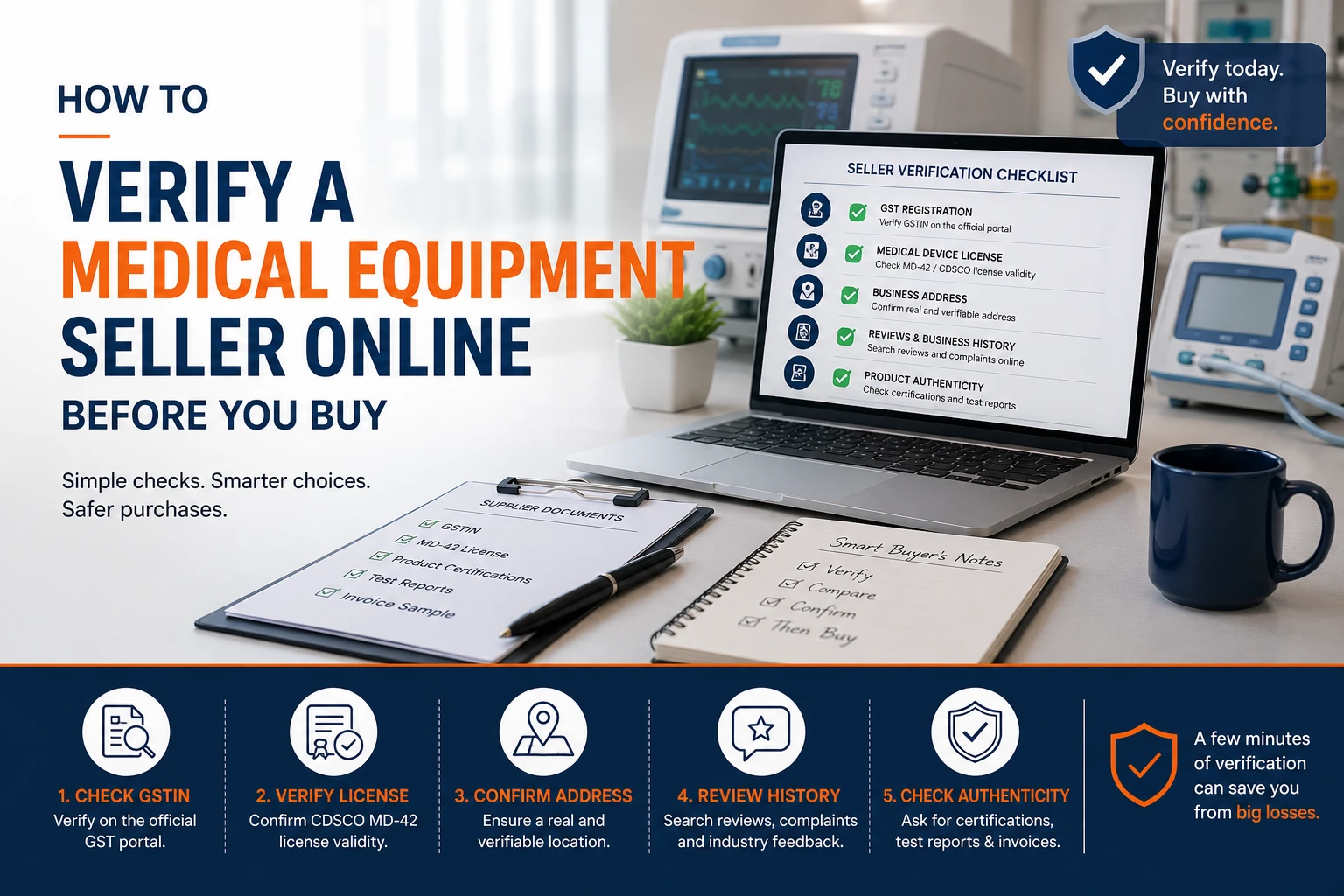
Search the seller's GSTIN on the government's GST portal at services.gst.gov.in under "Search Taxpayer," and confirm the legal name, registration status, and state match what the seller told you. Running this check protects your input tax credit, since a supplier with an inactive GSTIN can't legally charge GST, and if they do, the liability for wrongly claimed credit falls on you.
Don't stop at "a GSTIN exists." Look for whether returns like GSTR-3B have been filed consistently for several months, since consistent non-filing means your input tax credit can be blocked even if the invoice itself looks fine. A GSTIN registered eight months ago with zero filing history is worth a follow-up call before you wire any advance.
Two quick sanity checks that catch most fakes:
- The first two digits of the GSTIN should match the state on the seller's invoice and address. A mismatch is a reason to ask questions, not necessarily a scam, but it needs an explanation.
- If the seller claims to be a private limited company but the entity code in the GSTIN reads like a proprietorship, that inconsistency is worth raising directly with them.
This is the single most useful check in this whole article, and it's free. If a seller resists sharing their GSTIN, that alone is close to disqualifying.
How do you confirm a seller holds the right medical device license?
Ask for the seller's Form MD-42 wholesale license number and verify it corresponds to a real, currently valid registration for the device category they're selling. The MD-42 license, issued by the CDSCO, is required for wholesalers, distributors, importers, retailers, and e-commerce sellers dealing in medical devices, and it's valid for five years before renewal is due.
This requirement isn't new, but it used to have gaps. Sellers of devices that weren't formally "notified" under the old rules were exempt from licensing, so many never bothered registering, but that exemption has closed: every medical device category is now notified, and dealers without an existing wholesale license must hold Form MD-42. Practically, that means there's no more legitimate excuse for a seller of oxygen concentrators, BP monitors, or infusion pumps to be unlicensed in 2026.
Importers carry an extra layer. If the seller is importing rather than manufacturing domestically, they should be able to point you to their listing or authorised-agent status on CDSCO's SUGAM portal at sugam.gov.in, which is the regulator's official online system. A seller who's vague about which license category applies to them, or who says "we don't need one for this product," is either wrong or hoping you won't check.
What does a classifieds-style listing site actually verify?
A plain classifieds model verifies that a seller can create an account, not that the seller is legally allowed to sell medical devices or has the stock they claim to have. The listing fee gets paid, a phone number gets confirmed by OTP, and the ad goes live. Everything after that, GST status, device licensing, actual inventory, is left entirely to the buyer to chase down.
That's not a flaw unique to any one platform; it's how classifieds marketplaces work by design, in medical equipment or otherwise. The trade-off is speed and low friction for sellers, at the cost of due diligence for buyers. If you're sourcing anything above a few thousand rupees, or anything that touches patient safety, treat "listed on a marketplace" as a starting point for research, not a substitute for it.
A genuinely GST verified supplier India buyers can trust will have documentation that survives the checks above, not just a live listing.
How do you check a seller's business history and reviews?
Search the company's registered name, not just their storefront or brand name, across Google, LinkedIn, and industry forums, and look specifically for complaints, not just star ratings. Star ratings on a seller's own listing page can be manufactured. A pattern of the same complaint (late delivery, refurbished units sold as new, no invoice provided) repeated across independent sources is much harder to fake.
Check how long the business has actually existed against how long they claim. The GST portal shows registration date. A seller whose website says "serving hospitals since 2011" but whose GSTIN was issued fourteen months ago is worth a direct question, not an accusation, just a question.
Ask for two references, ideally hospitals or clinics, not other equipment resellers. A seller who has genuinely supplied ventilators to a district hospital will give you that hospital's procurement contact without hesitation. A seller who stalls on this request is telling you something too.
What documents should a trusted medical equipment vendor share before you pay?
A trusted medical equipment vendor should hand over, without you having to ask twice: a GST-compliant tax invoice with a verifiable GSTIN, the relevant CDSCO license or registration number for the device class, a product-specific quality or calibration certificate, and a written warranty or return policy. If any one of these is missing, that's the gap to close before payment, not after.
For imported devices specifically, ask for the Free Sale Certificate or equivalent from the country of origin and the name of the Indian Authorised Agent handling the import. Legitimate importers appoint an Indian entity to act as their Authorised Agent, and that agent is expected to hold a valid wholesale or manufacturing license before the device is legally allowed to enter Indian hospitals or clinics.
Keep copies of everything the seller sends you, even before you've decided to buy. If a dispute happens later, a WhatsApp screenshot of a GSTIN or license number is far more useful than a memory of having seen one.
Take a real example. A clinic in Pune sourcing a patient monitor asked its shortlisted seller for four things by email: the GSTIN, the MD-42 number, a photo of the actual unit with a visible serial number, and a signed quotation on letterhead. The seller sent all four within the hour. A second seller, offering the same model for 15% less, went quiet after the request. The clinic bought from the first seller. The price gap turned out to be the cost of the paperwork the second seller didn't have.
What red flags signal a fake medical equipment seller?
The single biggest red flag is pressure to pay the full amount upfront by personal UPI or bank transfer, especially when combined with urgency ("only one unit left, confirm in the next hour"). Genuine B2B medical equipment suppliers are used to partial advances, purchase orders, and payment terms; only fraudulent listings need you to move fast before you can think.
Other patterns worth treating seriously:
- A GSTIN that returns "Cancelled" or "Suspended" status, or one where the legal name doesn't match the seller's business name at all.
- Product photos that appear, reverse-image-searched, on five other unrelated listings.
- A seller who only communicates through personal WhatsApp and refuses a registered business email or a landline.
- Prices dramatically below every other listing for the same model, with no explanation (liquidation stock, end-of-life model, refurbished unit) offered unprompted.
- Reluctance to issue a proper tax invoice, or an offer to "skip GST" for a lower price. This is itself illegal and a strong signal the transaction has no real accountability behind it.
None of these alone proves fraud. Two or more together, on a purchase above a few thousand rupees, is reason enough to walk away or verify further before paying.
How should you pay to stay protected?
Where possible, use a payment method that leaves a documented trail and some recourse if things go wrong, a business bank transfer against a formal invoice and purchase order, rather than a personal UPI ID. For first-time sellers and larger orders, split payment into an advance and a balance due on delivery and inspection, and put that split in writing before you send anything.
If a marketplace or platform offers escrow or payment protection, use it, even if it adds a small fee. That fee is cheap compared to a lost advance with no seller to chase.
Frequently asked questions
Is a GST number enough to trust a medical equipment seller? No. A valid GSTIN confirms tax registration, not that the seller is licensed to sell medical devices or has genuine stock. Treat it as one check among several, not proof on its own.
Do all medical equipment sellers in India need a CDSCO license? Yes, as of the current rules, dealers, distributors, and e-commerce sellers of medical devices need Form MD-42 or an equivalent existing wholesale license, since every device category is now notified under the Medical Device Rules.
Can I verify a seller's GST number without creating an account? Yes. The GST portal's taxpayer search is free, requires no login, and returns status, legal name, and registration date within seconds.
What should I do if a seller refuses to share their GSTIN or license number? Treat that refusal as a decision point, not a negotiation. A genuine business selling medical equipment has no legal reason to withhold either document from a paying buyer.
The fifteen-minute habit that avoids most losses
None of these checks require special tools or a lawyer. A GST portal search, a license number cross-check, and a request for two references cover most of the risk in a typical purchase. The sellers worth buying from will hand this information over before you finish asking.
If you're comparing suppliers for a larger purchase, order, tender, or repeat sourcing relationship, it's worth working from a directory that has already run these checks rather than re-verifying each listing from scratch, particularly on classifieds-style sites where that verification was never built into the listing process to begin with.

Author
Devendra Sharma
Related posts


15-4-2026
Top 20 Lab Equipment for Diagnostic Labs