 Medical Equipment
 Hospital Furniture
 Medical Disposables
 Rehabilitation
 Diagnostic & Labware
 Eyes & ENT
 Critical Care Equipment
 Urology
 Aesthetic & Dermatology Equipment
 Gastroenterology
 OT Equipment
By Devendra Sharma On 19-10-2026 at 4:34 pm
Labour Room Equipment List: Maternity Hospital Setup Guide
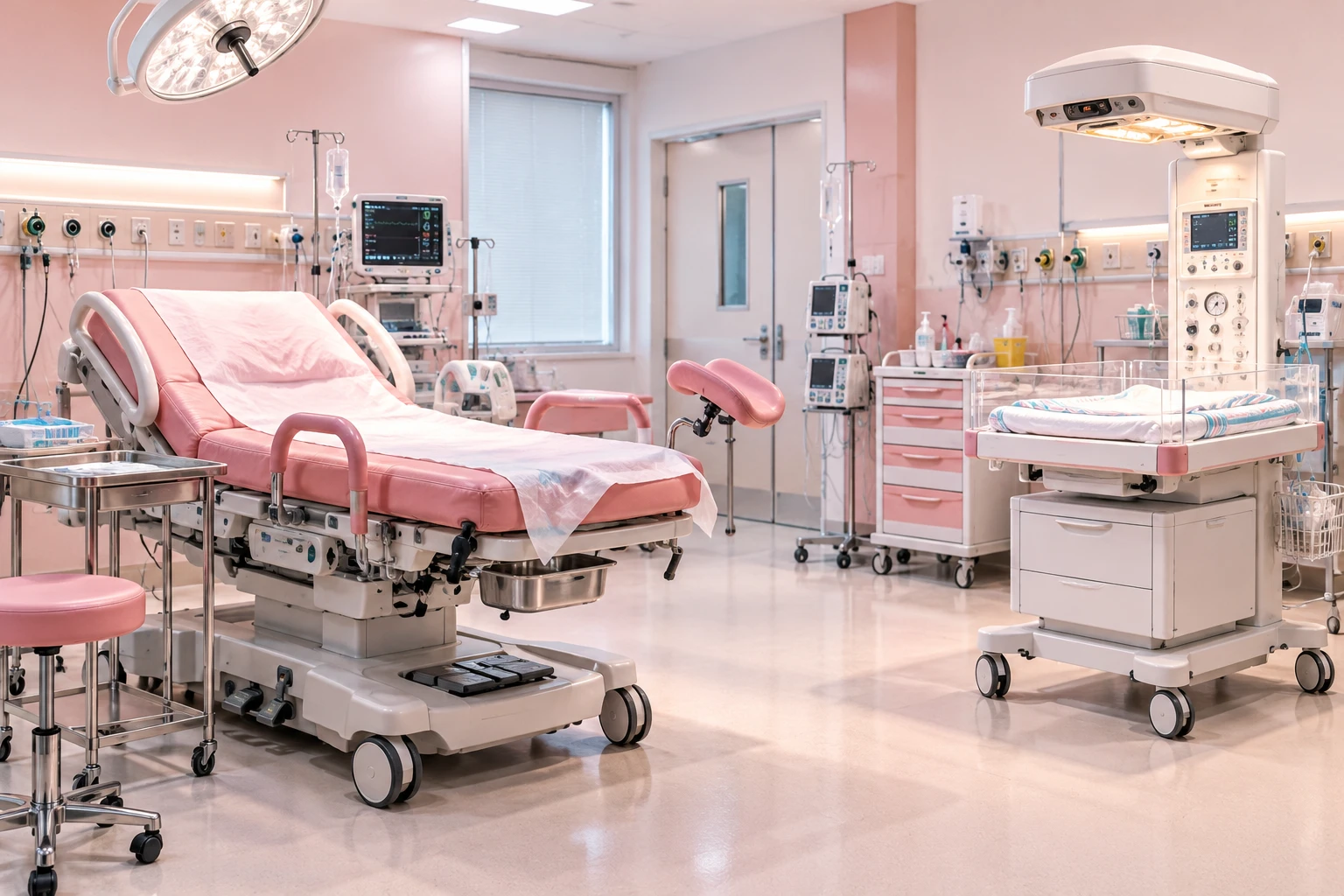
A functioning labour room needs two equipment zones that work together but serve different patients at the same moment, the mother's delivery area and the newborn resuscitation corner, and treating the second as an afterthought to the first is one of the most consequential equipment planning mistakes a new maternity facility can make. India's own maternal and newborn care standardisation guidance under the National Health Mission treats labour room equipment as a defined, auditable list precisely because gaps in this specific room have an outsized effect on outcomes compared to almost any other department in a hospital. This guide covers the complete equipment list, how to think about the two zones together, and what first-time maternity facility owners in Rajasthan most often get wrong.
Key Takeaways
- A labour room has two equipment zones, the delivery area for the mother and the newborn resuscitation corner, and both need to be fully equipped, not just the delivery area that is more visually obvious to a first-time buyer.
- The newborn resuscitation corner is the single most commonly underequipped part of a new labour room, despite being used at every single delivery.
- Partograph monitoring and basic fetal monitoring equipment are not optional extras, they are core to safe labour management, not an advanced add-on for only high-risk cases.
- Instrument sterilisation capacity needs to match delivery volume specifically, not be assumed from your hospital's general sterilisation setup.
- A labour room's equipment list connects directly to RGHS and MAA Yojana empanelment requirements if your facility plans to offer maternity packages under either scheme.
The Two Zones: Why Both Need Equal Planning Attention
A labour room is really two connected clinical spaces operating simultaneously during every delivery. The delivery area equips the mother's side: a labour and delivery table, maternal monitoring equipment, instruments for the delivery itself, and immediate postpartum care supplies. The newborn resuscitation corner equips the baby's side: a radiant warmer, suction equipment, bag and mask resuscitation devices, and a flat, well-lit surface positioned close enough to the delivery table for an immediate handover without delay. First-time facility owners consistently invest more attention and budget in the delivery area simply because it is the larger, more visually prominent piece of equipment in the room, while the resuscitation corner, despite being needed at every single delivery without exception, often ends up equipped as a secondary consideration. This is backwards from how the two zones should actually be prioritised, since a delay or gap in newborn resuscitation capability carries consequences that compound in minutes, not hours.
The Delivery Area Equipment List
Labour and delivery table
The central equipment piece, needs adjustable positioning for different stages of labour and delivery, and should be selected with your facility's actual delivery volume and case mix in mind, not simply the lowest-priced option available locally.
Maternal monitoring equipment
Basic vital signs monitoring, blood pressure, pulse, temperature, alongside fetal heart rate monitoring through a handheld Doppler device or a continuous cardiotocography (CTG) machine for higher-risk deliveries. A facility handling any meaningful volume of deliveries should not treat CTG monitoring as an optional upgrade reserved only for complicated cases, since risk during labour can emerge without clear advance warning.
Partograph and labour monitoring tools
A partograph, the standardised chart used to track labour progress against expected norms, is a low-cost, high-value tool that every labour room should use consistently, and staff training on correct partograph use matters as much as having the chart itself available.
Delivery instrument set
Sterile instrument trays for normal delivery and for assisted delivery when needed, episiotomy and suturing instruments, and cord clamping equipment. These are consumed and resterilised constantly, which makes sterilisation turnaround capacity a direct constraint on how many deliveries your labour room can safely handle in a busy period.
Oxygen and suction for the mother
Maternal oxygen delivery and suction equipment, separate from the newborn resuscitation corner's own suction setup, since both mother and baby may need suction support simultaneously during a complicated delivery.
The Newborn Resuscitation Corner Equipment List
Radiant warmer
A dedicated newborn radiant warmer positioned immediately adjacent to the delivery area is the centrepiece of this zone, providing thermal support that is critical for every newborn, not only those requiring active resuscitation. Our Baby Warmer Buying Guide covers specification and price in full detail.
Newborn suction equipment
Dedicated, appropriately sized suction catheters and a suction device separate from the mother's equipment, since both may be needed at the same critical moment.
Bag and mask resuscitation devices
Appropriately sized for newborns specifically, not adapted from general-purpose adult or paediatric equipment, since correct sizing directly affects resuscitation effectiveness.
Resuscitation surface and timer
A flat, firm surface at the warmer and a visible timer are both standard requirements under national newborn care protocols, since timed intervention is a core part of correct resuscitation technique, not a detail to be estimated by instinct in the moment.
Oxygen supply with appropriate flow control
Newborn oxygen delivery requires flow control appropriate to neonatal needs, distinct from adult oxygen delivery systems used elsewhere in the facility.
Equipment List at a Glance
| Zone | Core equipment | Commonly underbudgeted item |
|---|---|---|
| Delivery area | Delivery table, maternal monitor, CTG, instrument sets | CTG machine, often treated as optional |
| Newborn resuscitation corner | Radiant warmer, suction, bag and mask, resuscitation surface | Dedicated newborn suction, sometimes shared improperly with maternal equipment |
| Shared infrastructure | Sterilisation capacity, oxygen supply, lighting | Sterilisation turnaround capacity relative to actual delivery volume |
Sizing Sterilisation Capacity to Actual Delivery Volume
A labour room's instrument sterilisation needs scale directly with delivery volume, and this is a detail many first-time facility owners estimate from a generic baseline rather than their own projected or actual case numbers. A facility running a handful of deliveries a week has very different turnaround requirements than one running several a day, and undersizing this capacity creates a bottleneck that can delay care during a busy period, exactly when delay carries the highest cost. Our ICU Setup Equipment Checklist and OT Setup Equipment Checklist both cover sterilisation equipment sizing in more depth, and the same underlying logic, sizing to actual volume rather than a generic assumption, applies directly to a labour room.
Connecting Your Equipment List to RGHS and MAA Yojana Empanelment
Maternity and obstetric packages are a significant category under MAA Yojana specifically, given the scheme's broad general-public reach, and a facility planning to offer these packages needs its labour room equipment to meet the specific requirements tied to those packages, verified against current scheme criteria rather than a general assumption carried over from basic registration requirements. Our guide on RGHS and MAA Yojana empanelment equipment planning covers this in full, and it is worth reading alongside this equipment list if empanelment is part of your facility's plan, since the two planning tracks are directly connected rather than sequential.
Staffing and Drills: Equipment Alone Is Not Enough
A fully equipped labour room still depends on staff who are trained and drilled in using that equipment correctly, particularly newborn resuscitation equipment, which is used under time pressure and requires muscle-memory familiarity rather than first-time-use learning during an actual emergency. National maternal and newborn care mentoring programmes place significant emphasis on regular obstetric and resuscitation drills for exactly this reason, and a facility that invests in correct equipment without a parallel commitment to regular staff drilling has only solved half of the actual safety problem. This connects directly to the staffing and equipment relationship we cover in our nursing home registration guide, where the same principle, equipment capability on paper is not the same as operational readiness, applies across every clinical department, not only the labour room.
Consumables: The Recurring Cost Behind Every Delivery
Beyond the one-time equipment purchase, every delivery consumes sterile gloves, delivery kits, cord clamps, suction catheters and a range of other consumables that recur with every single birth, not periodically like most equipment maintenance. A facility budgeting primarily for equipment while treating consumables as a minor afterthought typically discovers this is one of the largest ongoing cost categories once the labour room becomes operational. Our sister platform H.O.P.E. runs a pooled procurement network for exactly this kind of recurring consumables spend across member facilities, and its maternity home consumables checklist is worth reviewing before your opening delivery, not after consumables costs have already become a recurring budget surprise.
Common Mistakes First-Time Maternity Facility Owners Make
Underequipping the newborn resuscitation corner relative to the delivery area is the most common and most consequential mistake, driven simply by which equipment is more visually prominent during initial setup planning. Treating CTG monitoring as optional rather than standard practice is a second common mistake, often justified by cost pressure without a full appreciation of how it affects early detection of labour complications. A third is sizing sterilisation capacity to a generic baseline rather than actual or projected delivery volume, which creates an avoidable operational bottleneck precisely during the busiest periods when it matters most.
Lighting, Layout and the Handover Distance Between Zones
The physical distance and layout between the delivery table and the newborn resuscitation corner is a design detail that is easy to overlook when equipment lists are planned purely as a shopping list rather than as a room layout problem. A resuscitation corner positioned too far from the delivery table, or separated by an awkward layout that slows the handover of a newborn needing immediate attention, undermines even a fully equipped setup. Adequate, shadow-free lighting over both zones independently, not a single shared light source that compromises visibility at one station while serving the other, is a similarly easy detail to underweight during initial planning but one that directly affects how quickly and safely staff can respond at either station.
New vs Refurbished Equipment for a Labour Room
The same new-versus-refurbished decision that applies to general hospital equipment applies to a labour room, but with a narrower margin for the refurbished option given the acuity of care delivered here. A delivery table or general furniture item can reasonably be considered refurbished with proper certification, while a radiant warmer, CTG machine or any equipment directly supporting newborn resuscitation deserves the same new-equipment caution applied to ICU-grade devices elsewhere in the hospital, since the consequences of an undetected fault at the moment of delivery are severe and immediate in a way that is difficult to fully price into a savings calculation.
Frequently Asked Questions
What is the most commonly underequipped part of a new labour room?
The newborn resuscitation corner, despite being used at every single delivery without exception. First-time owners consistently prioritise the more visually prominent delivery area first and treat the resuscitation corner as a secondary consideration.
Is CTG monitoring necessary for every labour room, or only high-risk cases?
It should be treated as standard practice, not an optional upgrade reserved for high-risk cases specifically, since labour complications can emerge without clear advance warning even in cases initially assessed as low risk.
How should sterilisation capacity be sized for a labour room?
To your facility's actual or realistically projected delivery volume, not a generic baseline figure, since undersizing creates a bottleneck exactly during busy periods when delay has the highest cost.
Does labour room equipment affect MAA Yojana empanelment specifically?
Yes, maternity and obstetric packages are a significant category under MAA Yojana, and your labour room equipment needs to meet the specific current requirements tied to whichever packages you plan to offer under that scheme.
Is staff training as important as the equipment itself?
Yes, particularly for newborn resuscitation equipment, which requires drilled familiarity rather than first-time learning under the time pressure of an actual emergency. Equipment capability on paper is not the same as operational readiness.
What consumables does a labour room need to budget for beyond the initial equipment purchase?
Sterile gloves, delivery kits, cord clamps, suction catheters and similar items that recur with every single delivery, representing one of the largest ongoing cost categories once the labour room is operational, not a minor afterthought to the one-time equipment budget.
Plan your labour room equipment list with verified sellers. Register on HOSPkart to compare rates across both the delivery area and newborn resuscitation corner.

Author
Devendra Sharma
Related posts



15-4-2026
Top 20 Lab Equipment for Diagnostic Labs