
 Medical Equipment
 Hospital Furniture
 Medical Disposables
 Rehabilitation
 Diagnostic & Labware
 Eyes & ENT
 Critical Care Equipment
 Urology
 Aesthetic & Dermatology Equipment
 Gastroenterology
 OT Equipment
By Devendra Sharma On 14-07-2026 at 5:06 pm
Patient Monitor Types and How to Choose the Right One in 2026
A patient monitor looks simple from the outside: a screen, a few cables, some beeping. Choosing the wrong one for your setting is where things get expensive, either because you overpaid for parameters nobody uses or underbought for a ward that actually needed continuous ECG and invasive pressure tracking.
This guide breaks down the types of patient monitor available in India, what a multipara monitor actually measures, where ICU-grade monitoring is worth the extra cost, and how to match a monitor to the ward it's going into.
What are the different types of patient monitor?
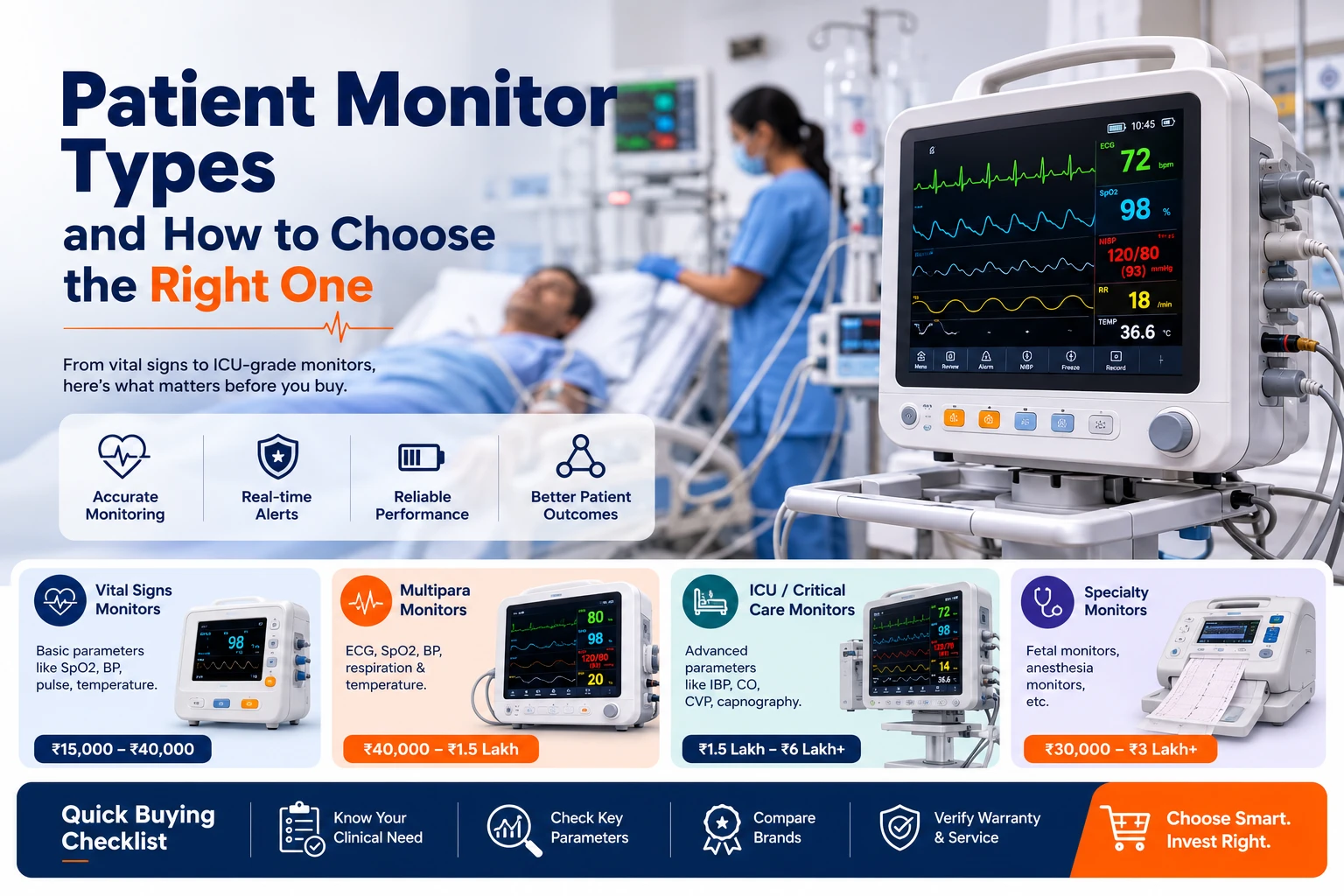
Patient monitors fall into four broad categories: vital signs monitors, multipara monitors, ICU/critical care monitors, and specialty monitors built for a single parameter like fetal heart rate or anesthesia depth. Each category is built for a different acuity level, and buying above or below that level wastes money either way.
Vital signs monitors are the entry point. They typically track blood pressure, SpO2, pulse rate, and temperature, and they're built for OPDs, general wards, and ambulances where a nurse checks in periodically rather than watching a continuous trace. Prices start around ₹15,000-40,000 for a basic unit.
Multipara monitors add continuous ECG, respiration rate, and often a second SpO2 channel or capnography, and they're the default choice for step-down wards, dialysis units, and procedure rooms. This is the category most Indian hospitals mean when they say "patient monitor" without qualification.
ICU/critical care monitors go further, adding invasive blood pressure (IBP), central venous pressure, cardiac output, and multi-channel capnography, built to run continuously for days on a single patient with alarm thresholds a nurse can customize per bed. These sit at ₹1.5-6 lakh depending on parameter count and brand.
Specialty monitors cover niche needs, like fetal monitors for labor rooms or BIS monitors for anesthesia depth during surgery, and they're usually bought alongside a general monitor rather than instead of one.
What is a multipara monitor and what features should you look for?
A multipara monitor is a bedside device that tracks multiple vital parameters simultaneously, typically ECG, SpO2, non-invasive blood pressure, respiration, and temperature, displayed as live waveforms and numeric trends on one screen. It's the standard monitor for general wards, step-down units, and outpatient procedure rooms in most Indian hospitals.
Screen size and split-screen capability matter more than most buyers expect. A 12-inch or larger display with a clear waveform view is genuinely easier for a busy nurse to read at a glance than a smaller screen crammed with numbers, and that difference shows up during a shift change when someone unfamiliar with the patient needs to assess status fast.
Battery backup is the feature that gets skipped in a quotation comparison and then regretted during a power cut. Look for at least 60-90 minutes of battery runtime, since that's roughly the gap most facilities need to bridge before backup generators stabilize.
Alarm customization is not cosmetic. A monitor that only offers factory-default alarm thresholds forces nurses to either tolerate false alarms constantly or silence alarms altogether, both of which are documented contributors to alarm fatigue in ward settings. Per-patient threshold adjustment should be a baseline requirement, not a premium add-on.
Central station connectivity, the ability to link multiple bedside multipara monitors to one nursing station display, is worth paying for in any ward with more than 6-8 beds, since it lets one nurse watch several patients from a single screen instead of walking the ward on a fixed schedule.
What is an ICU patient monitor used for?
An ICU patient monitor is used for continuous, high-acuity tracking of critically ill patients, covering invasive hemodynamic parameters like arterial blood pressure and cardiac output alongside standard vitals, with configurable alarms tied to each patient's specific risk thresholds. It's built to run uninterrupted for the length of an ICU stay, not intermittently.
The core difference from a ward monitor is invasive parameter support. An ICU monitor connects to arterial lines for continuous blood pressure, central lines for CVP, and sometimes pulmonary artery catheters for cardiac output, none of which a standard multipara monitor is built to interface with.
Trend data storage matters more in ICU settings than anywhere else in the hospital. A monitor that stores 24-72 hours of parameter trends lets an intensivist review how a patient's condition evolved overnight rather than relying only on nursing notes, which is a meaningfully different clinical picture during rounds.
Networked alarm escalation is standard in most modern ICU builds. If a bedside alarm isn't acknowledged within a set window, it should escalate to the nursing station and, in better systems, to a mobile device carried by the on-duty staff, so a missed bedside alarm doesn't become a missed critical event. Most facilities buy these monitors alongside the rest of an ICU bed setup and critical care accessories like syringe pumps and suction units, since an ICU bay rarely gets built one item at a time.
What's the difference between a vital signs monitor and a multipara monitor?
A vital signs monitor tracks basic parameters, usually SpO2, blood pressure, pulse, and temperature, on an intermittent or spot-check basis, while a multipara monitor adds continuous ECG and respiration tracking with live waveform display for ongoing patient assessment. The gap is continuous versus intermittent monitoring, not just parameter count.
For an OPD or a general ward doing periodic checks every few hours, a vital signs monitor is enough and considerably cheaper. Buying a full multipara monitor for a setting that only needs spot checks means paying for continuous ECG capability that never gets used.
For any bed where a patient's condition could change within minutes rather than hours, post-op recovery, dialysis, step-down after ICU discharge, a multipara monitor is the safer baseline, since the continuous ECG trace is what catches an arrhythmia between nursing rounds.
What parameters should a patient monitor measure?
A patient monitor should measure ECG, SpO2, non-invasive blood pressure, respiration rate, and temperature at minimum for general ward use, with capnography, invasive blood pressure, and cardiac output added for ICU and OT settings. Choosing parameters should follow the clinical setting, not the other way around.
| Setting | Minimum parameters | Typical price range |
|---|---|---|
| OPD / general ward | SpO2, NIBP, pulse, temperature | ₹15,000-40,000 |
| Step-down / procedure room | ECG, SpO2, NIBP, respiration | ₹40,000-1.2 lakh |
| ICU / critical care | ECG, SpO2, NIBP, respiration, IBP, capnography | ₹1.5-6 lakh |
| OT (with anesthesia) | ECG, SpO2, NIBP, capnography, gas analysis, BIS | ₹2-8 lakh |
Capnography, which measures exhaled CO2, is increasingly treated as a baseline requirement rather than an upgrade, particularly for any patient under sedation or on a ventilator, since it catches respiratory depression faster than SpO2 alone.
How do you choose the right patient monitor for your hospital or clinic?
Choosing the right patient monitor means matching parameter set to acuity level, checking display size and alarm customization for the staff who'll use it daily, confirming battery backup and central station compatibility, and verifying after-sales service availability before comparing price. Price should be the last filter, not the first.
Start with acuity, not budget. Map every bed type in your facility, OPD, general ward, step-down, ICU, OT, and assign a minimum parameter set to each before requesting quotations. This prevents the common mistake of standardizing on one monitor model across the whole facility because it was easier to negotiate a bulk price.
Ask about local service turnaround before signing anything. A patient monitor that goes down and takes three weeks to get serviced is a bed that's effectively out of use, and in a small or mid-size hospital that's a real capacity loss, not just an inconvenience.
Check interoperability with your existing central station or hospital information system if you already have one. A monitor with excellent specs that can't talk to your existing nursing station display creates a workflow gap that undoes most of the benefit of buying it.
This is also the stage where sourcing from a verified B2B marketplace pays off. On HOSPkart, patient monitors are filterable by parameter set and screen size within the patient monitoring category, so you can shortlist by acuity level first and compare sellers second, instead of getting quotations from five separate distributors and reconciling specs manually.
What does a patient monitor cost in India, and where should you source it from?
Patient monitors in India range from ₹15,000 for a basic vital signs monitor to ₹8 lakh for a fully configured ICU or OT monitor, with most general ward multipara monitors falling between ₹45,000 and ₹1.5 lakh. Actual pricing depends on brand, parameter count, screen size, and warranty terms.
Buying from an unverified seller carries the same risk with monitors as it does with any capital medical equipment: unclear service history, no confirmed GST invoice, and warranty documentation that may not actually be honored by the manufacturer. A monitor that fails a calibration check six months in is a bigger problem than a slightly higher upfront price would have been.
HOSPkart lists patient monitors, ECG machines, and defibrillators from a verified seller network, so a hospital sourcing monitors for a new ward can compare specs and pricing across brands without separately vetting each vendor's GST status and service record. That's a meaningful time saver when you're outfitting more than a handful of beds at once.
Frequently asked questions
Do I need an ICU-grade monitor for a step-down ward? No. A step-down ward typically needs a standard multipara monitor with continuous ECG and SpO2; invasive parameters like IBP are usually unnecessary outside true ICU beds.
What's the minimum battery backup a patient monitor should have? Look for at least 60-90 minutes of runtime, enough to bridge most power outages until backup generators stabilize.
Is capnography necessary on a general ward monitor? It's not standard on general ward monitors but is increasingly recommended for any patient under sedation, even outside the ICU.
How often should a patient monitor be calibrated? Most manufacturers recommend calibration checks every 6-12 months, though high-use ICU monitors are often checked more frequently as part of a preventive maintenance contract.
Matching monitor type to ward acuity is the biggest cost and safety decision in this purchase, and it's worth getting right before comparing brands. You can browse patient monitors and critical care equipment on HOSPkart to compare configurations from verified sellers in one place.

Author
Devendra Sharma
Related posts




15-4-2026
Top 20 Lab Equipment for Diagnostic Labs