 Medical Equipment
 Hospital Furniture
 Medical Disposables
 Rehabilitation
 Diagnostic & Labware
 Eyes & ENT
 Critical Care Equipment
 Urology
 Aesthetic & Dermatology Equipment
 Gastroenterology
 OT Equipment
By Devendra Sharma On 20-07-2026 at 5:21 pm
Red Flags Buying Medical Equipment on Classifieds Sites
A ventilator listed 40 percent below market price on a classifieds site looks like a great deal right up until the payment clears and the seller goes quiet. Hospitals, clinics, and even individual buyers turn to classifieds sites for medical equipment because prices undercut authorized dealers and inventory moves fast, but that same openness makes these sites a favorite hunting ground for fraud. This guide walks through the red flags that separate a genuine listing from a scam, and what to verify before any payment leaves your account.
Why do hospitals and clinics turn to classifieds sites for medical equipment in the first place?
Classifieds sites appeal to buyers because listings update constantly, prices undercut authorized dealers, and sellers often ship faster than a formal procurement process allows. That same speed and lack of verification is exactly what scammers rely on to get paid before anyone checks their claims.
Smaller clinics and standalone diagnostic centers feel this pull hardest. A tighter budget makes a steep discount hard to walk away from, and a broken monitor mid-week creates enough urgency that due diligence quietly gets skipped in favor of getting equipment back online fast.
None of that makes classifieds sites inherently unsafe. It just means the burden of verification shifts almost entirely onto the buyer, since there's no platform vetting sellers the way a dedicated marketplace would.
Why is medical equipment a bigger target for scammers than ordinary classifieds goods?
High price tags and genuine urgency make medical equipment a more attractive target than furniture or electronics, since a buyer under pressure to get a ventilator or monitor back in service is more likely to skip steps they'd normally take their time on. Scarcity spikes, like the ones seen during COVID-19 when demand for ventilators and oxygen concentrators outpaced supply, make the problem worse.
The FBI issued a specific warning during that period flagging unusual payment terms, particularly suppliers demanding upfront payment or proof of payment from buyers they'd never worked with before, as one of the clearest indicators of fraud in medical equipment sales. That guidance still holds outside of a pandemic. A supplier with no track record asking for money before delivery is a pattern worth treating with suspicion regardless of how urgent your own need feels.
Equipment brokers add another layer of risk worth naming directly. A listing that routes through an unfamiliar third-party broker, rather than a manufacturer or an authorized dealer you can verify independently, removes a layer of accountability exactly when you need it most.
What payment red flags should you never ignore on a classifieds listing?
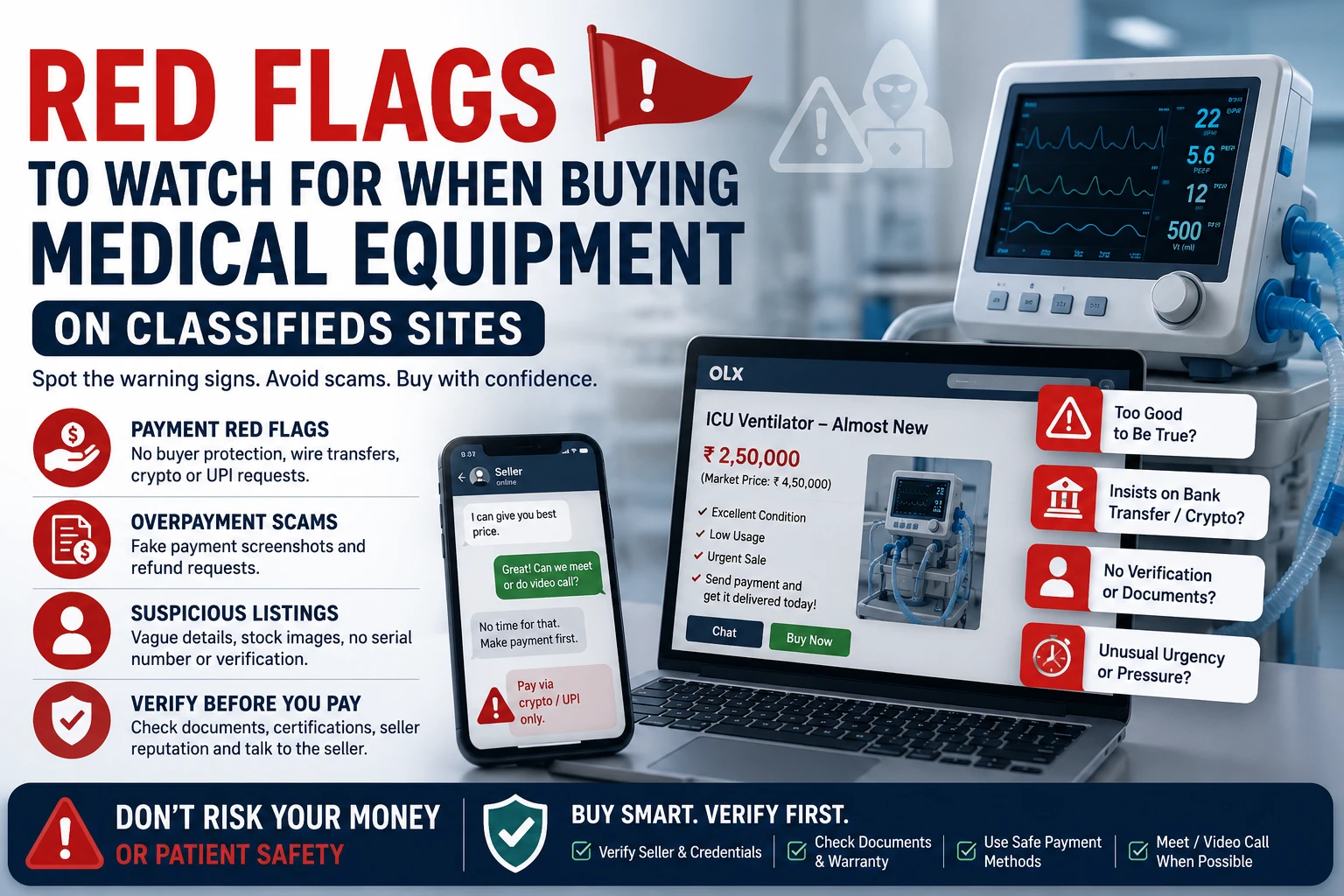
A seller who refuses credit card, escrow, or any payment method that offers buyer protection is telling you something important before you've even asked a follow-up question. Fraudulent sellers consistently favor payments that are hard to trace or reverse, and a poorly written listing full of grammatical inconsistencies is a supporting signal worth noticing on its own.
Wire transfers and cryptocurrency top the list of payment methods scammers push for, since both are close to impossible to reverse once sent. If a seller insists on one of these for a piece of equipment worth lakhs of rupees, that alone is reason enough to walk away.
In India specifically, a common variation runs through UPI apps rather than wire transfers. The buyer "requests" money through an app like Paytm or Google Pay and asks the seller to approve the request, betting that the seller mistakes the request notification for an incoming payment and enters their UPI PIN to "receive" money that actually gets debited instead.
How do overpayment and fake screenshot scams work on classifieds sites?
The pattern stays remarkably consistent across countries even when the payment method changes. A fraudster sends a fake payment screenshot showing an amount larger than the asking price, then asks the seller to refund the difference, and the seller wires back real money against a payment that never actually arrived.
One documented version of this scam has a buyer send a fake screenshot showing 50,000 rupees for a 20,000 rupee item, then request a 30,000 rupee refund on the difference. By the time the seller realizes no money actually landed in their account, the refund is long gone.
The same trick shows up in markets that still rely on cashier's checks. A buyer sends a check for more than the asking price and asks the seller to wire back the difference to a shipping company, and once the original check bounces days later, the wired money is gone along with it.
What listing red flags suggest a seller isn't legitimate?
Unusual urgency, an unwillingness to meet in person or on a video call, and vague or evasive answers to direct questions are the three signals worth testing before you send a single rupee. A legitimate seller answers specifics about serial numbers, service history, and certification without hesitation.
Call or message the seller with a technical question a genuine owner would answer easily, like the exact model number or the date of last servicing. Vague responses, or answers that don't match the listing details, are worth treating as a decline rather than a delay.
No reviews, no verifiable business address, and a seller who's only reachable through a personal phone number rather than a registered business line round out the pattern. None of these individually proves fraud, but two or three together are reason enough to look elsewhere.
How do counterfeit parts hide inside "refurbished" equipment?
Counterfeit components get installed inside original manufacturer casings often enough that the outside of a device tells you almost nothing about what's actually working inside it. Ultrasound transducers are a well documented example, where low-quality replacement parts get represented as OEM-equivalent without the testing or certification that claim would require.
This is exactly why a serial number matters more than a brand name printed on the housing. A device's outer shell can be entirely genuine while its internal components have been swapped for parts that were never tested against the manufacturer's original specifications.
Buyers who can't inspect a device in person, which describes most classifieds transactions, have almost no way to catch this kind of substitution before money changes hands.
What's the difference between a warranty-backed refurbished device and an "as-is" classifieds listing?
An "as-is" listing shifts all repair risk onto the buyer the moment payment clears, with no warranty and no service-level agreement to fall back on if the device fails in its first week. Proper refurbishment includes calibration, functional testing, and documented parts replacement, none of which a cosmetic cleaning job on a classifieds listing is likely to include.
Ask for serial-number specific documentation before paying anything, not a generic brochure about the model. That means dated, signed electrical safety test results and calibration certificates tied to the actual unit you're buying, not a sample certificate copied from a different device of the same model.
A missing warranty isn't just an inconvenience if the equipment fails. It means every future repair, part, and technician visit comes entirely out of your budget, which quietly erases whatever savings the classifieds price originally offered.
What should you always verify before paying for equipment listed on a classifieds site?
Confirm the seller's business registration and CDSCO documentation directly with the regulator rather than trusting whatever paperwork the seller hands over. Insist on an in-person inspection or a live video call walkthrough of the actual unit before any money changes hands, and never send the full payment before delivery and inspection are complete.
Keep a simple habit: search the seller's phone number, email address, and any names mentioned in the listing before responding. Scam operations frequently reuse the same contact details across multiple fake listings, and a quick search often surfaces a previous victim's complaint.
If a cashier's check or bank transfer is involved, verify the issuing bank directly through a number you find independently, never the number printed on the check or message itself, since that number often just reconnects you to the scammer.
What should you do if you've already sent payment to a suspected scammer?
Contact your bank or payment provider immediately and ask them to flag or reverse the transaction, since the window to stop or claw back a payment closes fast, often within hours for UPI and digital transfers. Document everything, the listing, messages, payment confirmation, and any phone numbers involved, before the scammer has a chance to delete their account.
File a complaint with your local cyber cell or consumer protection body right away rather than waiting to see if the equipment shows up. In India, the National Cyber Crime Reporting Portal accepts complaints for exactly this kind of online payment fraud, and having a filed complaint on record also strengthens any bank dispute you raise separately.
Search for the seller's phone number and listing details online before writing off the loss entirely. Scam operations frequently reuse the same contact information across many fake listings, and other victims posting about the same seller can help build a case that's harder for a bank or platform to dismiss.
How does a verified B2B marketplace reduce these risks?
A verified marketplace removes most of the guesswork by checking seller credentials, business registration, and equipment documentation before a listing ever goes live, rather than leaving that entire burden on the buyer deal by deal. That upfront screening is the single biggest structural difference between a classifieds post and a vetted supplier listing.
This is exactly the gap HOSPkart is built to close. HOSPkart vets manufacturers and sellers before they're allowed to list, so buyers aren't relying on a stranger's unverified claims about CDSCO registration or calibration history sitting in an anonymous classifieds post. Sourcing critical care equipment or patient monitors through a platform where every seller has already been checked removes most of the verification work that classifieds buyers otherwise have to repeat with every single purchase.
That said, no platform replaces basic diligence entirely. Even on a verified marketplace, it's worth checking serial numbers, warranty terms, and documented service history before a purchase order goes out, since the goal is reducing risk, not eliminating the need to look.
Frequently asked questions
Is it safe to buy medical equipment from OLX or Quikr?
It can be reasonably safe if you verify the seller in person and use traceable payment, but these platforms don't screen sellers, so the fraud risk is meaningfully higher than with a verified marketplace.
What is the most common medical equipment classifieds scam?
The most common pattern is an overpayment or fake screenshot scam, where the buyer claims to have paid more than the asking price and asks the seller to refund the difference.
How can I verify if a used ventilator or monitor is genuine?
Ask for serial-number specific calibration and electrical safety test certificates, and confirm the CDSCO registration number directly with the regulator rather than trusting the seller's paperwork.
Should I ever pay in advance for medical equipment on a classifieds site?
Avoid paying the full amount before inspecting or receiving the equipment, since advance payment is the single most common trigger across classifieds fraud patterns.
What's a safer alternative to buying medical equipment from classifieds sites?
A verified B2B marketplace that checks seller credentials and equipment documentation before listing removes most of the risk that comes with anonymous classifieds postings.

Author
Devendra Sharma
Related posts




15-4-2026
Top 20 Lab Equipment for Diagnostic Labs