 Medical Equipment
 Hospital Furniture
 Medical Disposables
 Rehabilitation
 Diagnostic & Labware
 Eyes & ENT
 Critical Care Equipment
 Urology
 Aesthetic & Dermatology Equipment
 Gastroenterology
 OT Equipment
By Devendra Sharma On 01-09-2026 at 3:22 pm
Types of Nebulizer Machines: A Clinical Buying Guide
A patient having an asthma attack in the OPD, a COPD patient in the ward needing scheduled bronchodilator therapy, a child in the pediatric unit who can't manage a metered-dose inhaler well: all of these situations depend on one device doing its job reliably. Choosing among the types of nebulizer machines available today isn't just a procurement line item, it directly affects how well respiratory therapy actually works on your floor. For hospital biomedical engineers, clinic owners, and respiratory therapy departments, understanding what separates a compressor nebulizer from an ultrasonic or mesh device is the first step toward equipping a facility that can handle real patient volume without compromising on care.
How a Nebulizer Works in Respiratory Therapy
A nebulizer converts liquid medication, typically a bronchodilator, corticosteroid, or saline solution, into a fine aerosol mist that a patient inhales through a mask or mouthpiece. This lets the medication reach deep into the airways and lungs directly, rather than relying on a patient's ability to coordinate a breath with a metered-dose inhaler. Nebulizers are widely used in asthma and COPD management, and in general respiratory therapy for patients who are too young, too breathless, or too unwell to use handheld inhalers effectively.
Because the mist is inhaled over several minutes of normal breathing, nebulizers work well even for patients in respiratory distress, and they remain a standard fixture in emergency departments, pulmonology wards, ICUs, and pediatric units across Indian hospitals.
The Three Main Types of Nebulizer Machines
Not all nebulizers work the same way, and the mechanism a device uses has a real effect on treatment time, medication compatibility, noise, and how easily it fits into a busy clinical workflow. Broadly, the types of nebulizer machines used in hospitals and clinics fall into three categories: compressor (jet), ultrasonic, and mesh.
Compressor (Jet) Nebulizers
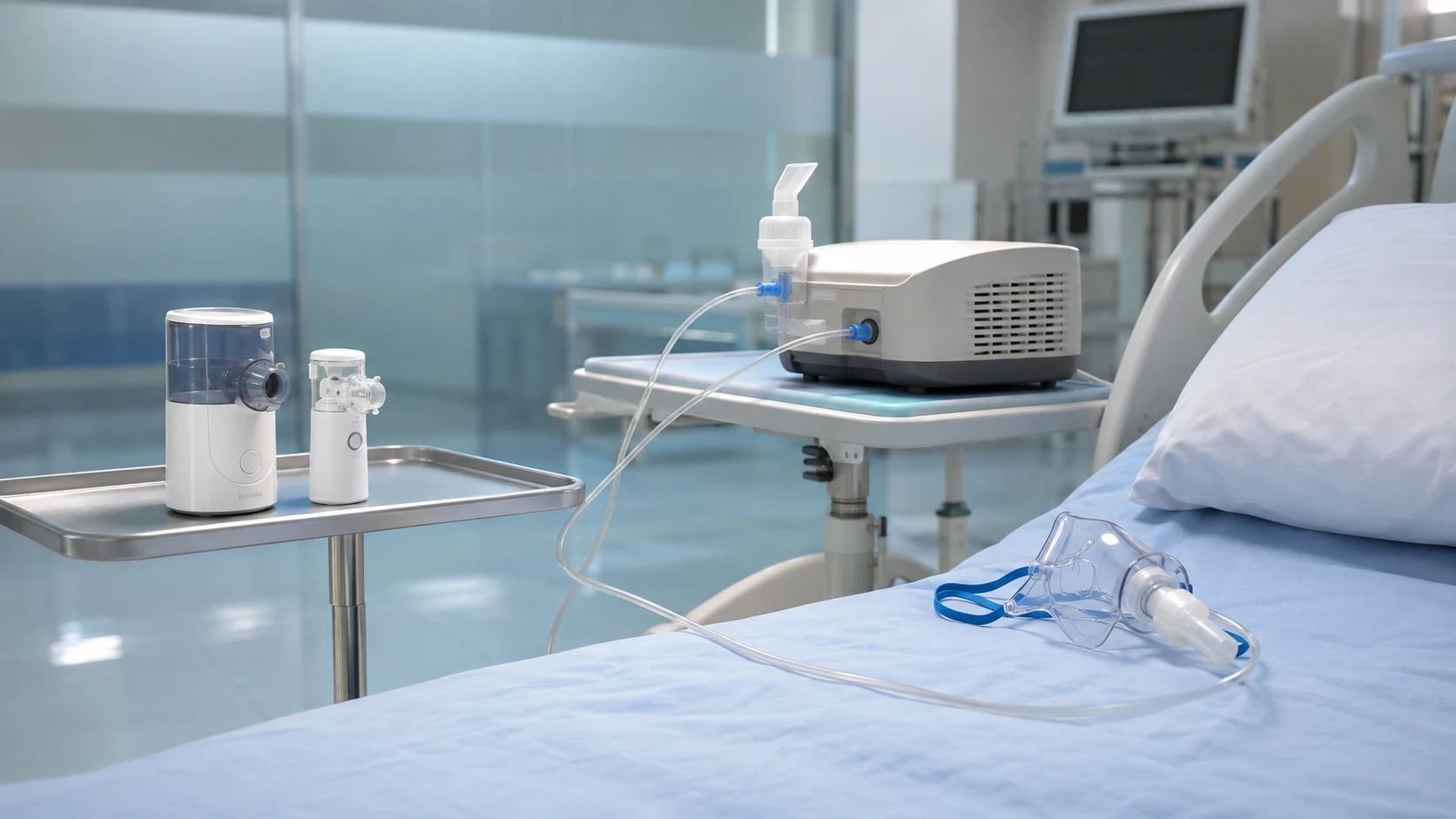
Compressor nebulizers, also called jet nebulizers, use a small air compressor to force pressurized air through a narrow jet, which draws liquid medication up through a tube and breaks it into a fine mist inside the nebulizer cup. This is the most established and widely used nebulizer technology in Indian hospitals and clinics, largely because it is rugged, inexpensive to maintain, and compatible with virtually every nebulized medication in standard use.
The tradeoff is size and noise. Compressor units are bulkier than ultrasonic or mesh devices and audibly noisier during operation, which matters in a quiet ward or a pediatric setting where a startled child can make treatment harder to complete.
Ultrasonic Nebulizers
Ultrasonic nebulizers use a high-frequency vibrating piezoelectric crystal to create vibrations in the medication reservoir, which breaks the liquid into an aerosol without any compressed air. This produces a fine mist with a shorter treatment time, and the devices tend to run more quietly than compressor units, which is genuinely useful for continuous ward use.
The key clinical limitation is medication compatibility. The heat and vibration generated by ultrasonic nebulization can degrade certain suspensions and some viscous or protein-based medications, so not every prescribed drug is suitable for this delivery method. Departments choosing ultrasonic devices need to confirm compatibility with their standard drug formulary before adopting them at scale.
Mesh Nebulizers
Mesh nebulizers use a fine, perforated membrane that vibrates at high frequency to push liquid medication through microscopic holes, producing an aerosol without heat and without the bulk of a compressor pump. This is the newest of the three technologies, and it has become popular for portable and home-care use, as well as in clinical settings that value compact size and near-silent operation.
Mesh nebulizers are generally compatible with a wider range of medications than ultrasonic devices, since they don't generate the same heat, but the mesh itself is more delicate and prone to clogging if not cleaned properly after every use, which matters a great deal in a high-turnover clinical setting.
Compressor vs Ultrasonic Nebulizer: A Practical Comparison
For departments choosing between these technologies, the compressor vs ultrasonic nebulizer decision usually comes down to patient volume, medication range, and how much noise a ward can tolerate. Mesh devices add a third option worth weighing for portability-focused use cases. The table below lays out how the three types compare across the dimensions that matter most in a clinical setting.
Choosing the Right Nebulizer for Hospital or Clinic Use
Selecting a nebulizer machine for hospital wards or a nebulizer for clinic use comes down to matching the device to how your department actually operates, not just picking whichever technology sounds most advanced. A few factors deserve real weight in the decision.
Patient volume and durability. A busy OPD or a general ward running dozens of treatments a day needs a device built for continuous use, not one designed around occasional home therapy. Compressor units generally hold up well under this kind of load, provided servicing is kept current.
Infection control between patients. In any shared clinical setting, the nebulizer cup, tubing, and mask need to be cleaned or replaced between patients without adding significant staff time. Devices with dishwasher-safe or easily disassembled components make this part of infection control protocol far more practical to maintain consistently.
Noise in ward and pediatric settings. A device that's disruptively loud can make treatment harder in a shared ward, and can turn a routine session into a distressing one for a young child. This is one of the clearer arguments for considering ultrasonic or mesh options in pediatric and continuous-care areas.
Portability for ward rounds. If therapy needs to move from bed to bed rather than patients coming to a fixed treatment point, a compact, easily transported unit matters more than raw output power.
For a facility weighing the best nebulizer machine India options for its specific case mix, the honest answer is usually a mix: compressor units for high-volume general use where medication compatibility can't be compromised, and ultrasonic or mesh devices where noise, portability, or bedside convenience matter more.
Buying Considerations Beyond the Device Itself
Once you've narrowed down the type, a few procurement details matter as much as the mechanism itself.
Medication compatibility with your formulary. Confirm the device works reliably with every nebulized drug your department prescribes, not just the most common ones, before committing to a bulk purchase.
Maintenance and servicing. Compressor motors, ultrasonic crystals, and mesh membranes all wear differently over time. Ask the supplier what routine servicing involves and how readily spare parts and accessories are available.
GST-verified sourcing. For institutional purchases, work with GST-verified sellers who can provide proper tax invoices and clear documentation, which matters for both audits and warranty claims down the line.
Warranty terms. Confirm what the warranty covers (motor, mesh, or crystal, not just the housing) and for how long, since this is exactly the component where devices tend to fail first under heavy clinical use.
Hospitals and clinics sourcing new equipment can browse nebulizers from certified manufacturers and GST-verified sellers on HOSPkart, comparing compressor, ultrasonic, and mesh options against the specifications your department actually needs, with Pan-India delivery so sourcing isn't limited by location.
Key Takeaways
Understanding the types of nebulizer machines available, compressor, ultrasonic, and mesh, helps respiratory therapy departments, clinics, and hospitals make a procurement decision based on actual clinical need rather than price alone. Compressor nebulizers remain the dependable, broadly compatible workhorse for high-volume settings, ultrasonic devices offer quieter, faster treatment with some medication limitations, and mesh nebulizers bring portability and near-silent operation at the cost of more delicate maintenance. Whichever type fits your department, prioritize medication compatibility, ease of cleaning between patients, and GST-verified sourcing with a clear warranty before you commit budget to a bulk purchase.

Author
Devendra Sharma
Related posts



15-4-2026
Top 20 Lab Equipment for Diagnostic Labs