 Medical Equipment
 Hospital Furniture
 Medical Disposables
 Rehabilitation
 Diagnostic & Labware
 Eyes & ENT
 Critical Care Equipment
 Urology
 Aesthetic & Dermatology Equipment
 Gastroenterology
 OT Equipment
By Devendra Sharma On 01-09-2026 at 3:25 pm
Types of Suction Machine and Their Clinical Uses in India
Ask any OT nurse or ICU staff member which piece of equipment they reach for most often without a second thought, and suction machines will almost always be on the list. They clear airways during emergencies, keep the surgical field visible during procedures, manage secretions in critically ill patients, and support routine ENT and wound care work. Yet many hospitals and clinics default to whatever unit a local vendor happens to stock, without really evaluating fit. Understanding the types of suction machine available, and matching each to its clinical setting, is a small planning step that prevents a much bigger operational headache later.
This guide covers what suction machines are used for, the major types of suction machine a facility is likely to need, the specifications worth checking before you buy, and how suction fits into a broader OT or ICU equipment plan.
What Medical Suction Machines Are Used For
A suction machine works on a simple principle: it generates negative pressure (vacuum) to draw fluids, secretions, blood, or debris out of the body through a connected tube and into a collection canister. Simple in concept, but genuinely important in practice, because a blocked airway or an obscured surgical field can turn a routine procedure into an emergency within seconds.
Common clinical applications include:
Airway clearance. Removing mucus, saliva, or vomit from the mouth and throat to keep an airway open, particularly in unconscious, sedated, or critically ill patients.
Surgical and OT use. Clearing blood and fluid from the operative site so surgeons have a clear view throughout a procedure.
Wound care. Managing exudate and drainage in certain wound management protocols.
ENT procedures. Clearing nasal and sinus secretions during ear, nose, and throat examinations and minor procedures.
Emergency and ambulance care. Keeping a patient's airway clear during transport, when suction access can genuinely be a matter of minutes.
Because suction shows up across so many departments, a medical suction machine for hospital use isn't a single-department purchase decision. OT, ICU, the emergency room, general wards, and ambulance services each have their own requirements, and one unit rarely serves all of them equally well.
Types of Suction Machine and Where Each One Fits
Broadly, hospitals and clinics in India work with three main types of suction machine, each suited to a different setting and level of urgency.
1. Electric, Mains-Powered High-Vacuum Suction Units
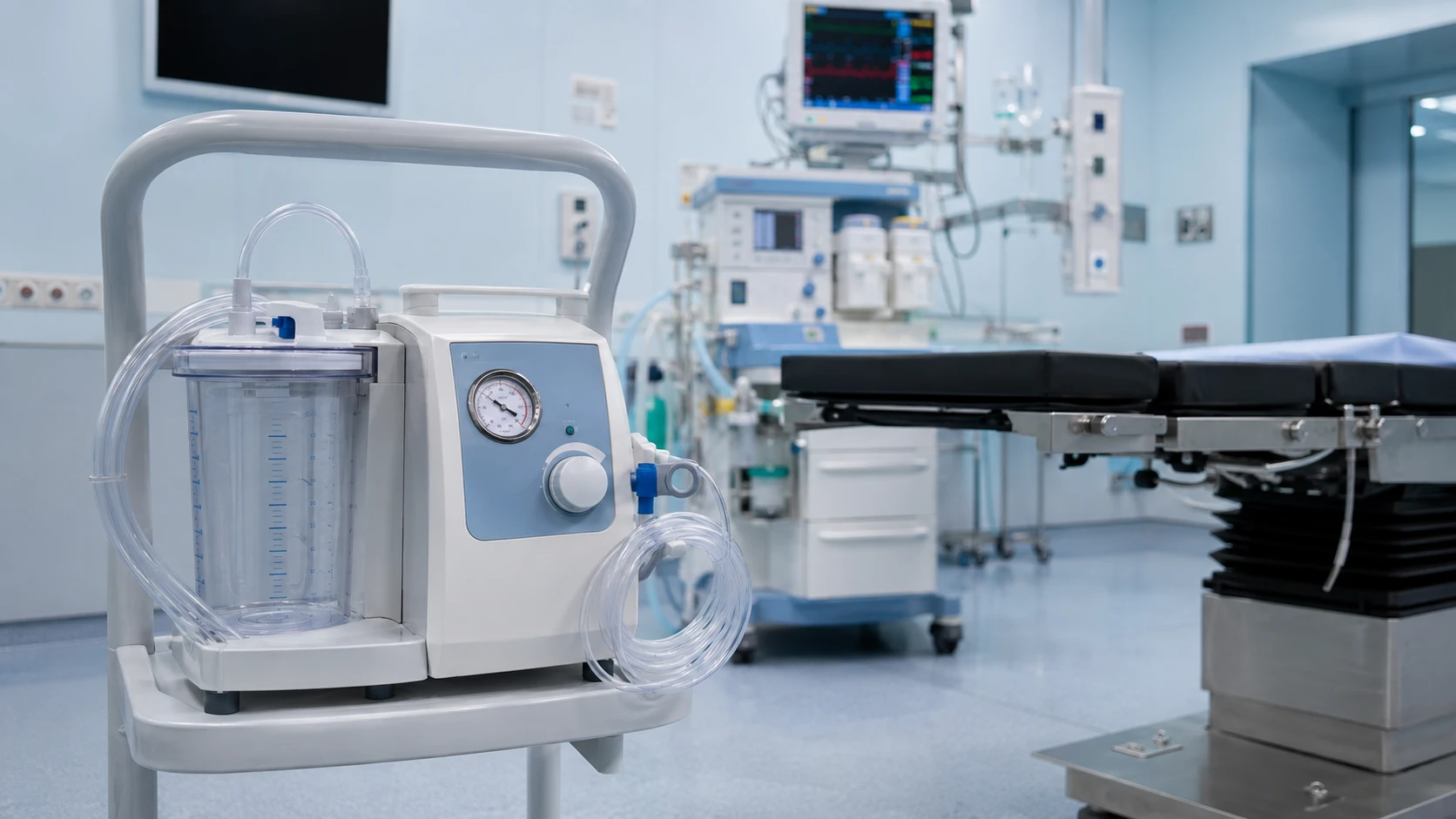
These are the workhorses of OT suction machine setups and ICU bays. Powered directly from the mains supply, they generate strong, sustained vacuum pressure and are built for continuous or frequent use during long surgical procedures and around-the-clock critical care.
Typically mounted on a mobile trolley or fixed to a wall unit near the OT table or ICU bed
Deliver high, adjustable vacuum levels suited to surgical suction and heavy secretion management
Often paired with larger canisters to reduce how often staff need to empty and reconnect during a procedure
Best suited to environments with a reliable, continuous power supply
2. Portable, Battery-Operated Suction Units
A portable suction machine is designed for mobility, exactly the opposite priority of a fixed OT unit. These run on rechargeable batteries, are compact enough to carry or mount on a stretcher, and are built to keep working when a patient moves.
Used in ambulances, where mains power isn't an option
Useful for ward-to-ward patient transfers and bedside use where a fixed unit isn't practical
Generally lighter and smaller than mains-powered units, with a shorter continuous run time on battery
A practical secondary or backup unit for departments that already have a fixed high-vacuum machine
3. Foot-Operated Manual Suction Units
Manual, foot-operated suction machines require no electricity or battery at all; vacuum is generated by the operator pumping a foot pedal. They're not a primary tool in a modern hospital, but they remain genuinely valuable as a backup option.
Works reliably during power outages or in facilities with unstable electricity supply
Requires no charging, no batteries, and minimal maintenance
Generates lower and less consistent vacuum than powered units, so it's suited to basic airway clearance rather than demanding surgical suction
Common in ambulances, rural health centers, and as an emergency backup in OTs and wards
Most hospitals run a mix of these types rather than standardizing on just one: a mains-powered unit in the OT and ICU, a portable suction machine for the emergency department and ward transfers, and a manual unit kept on hand as a genuine backup for power failures.
Key Specifications to Evaluate Before Buying
Once you know which category of suction machine you need, the next step is comparing units on the specifications that actually affect day-to-day performance. A suction machine buying guide worth following should walk through each of these before a purchase order goes out.
Vacuum pressure range. Check the adjustable range in mmHg or kPa. Surgical and ICU use generally needs a higher maximum vacuum than routine airway clearance, and the ability to adjust the level precisely matters for patient safety.
Canister capacity. Larger canisters (commonly 1 to 5 litres) mean fewer interruptions to empty and reconnect during long procedures or high-secretion cases, but they also add bulk and weight.
Noise level. A loud suction unit is more than an annoyance; in a ward or ICU setting, excessive noise adds to patient and staff stress during already difficult moments.
Portability. Weight, handle design, wheeled trolleys, and battery runtime all determine how practical a unit is to move between beds or into an ambulance.
Ease of cleaning and infection control. Detachable, autoclavable canisters and tubing, along with anti-overflow filters that protect the pump from fluid ingress, reduce cross-contamination risk and simplify daily disinfection between patients.
Backup power or battery option. Even a primarily mains-powered unit benefits from a battery backup for short transfers or power interruptions.
After-sales support. Spare tubing, replacement canisters, filters, and service availability matter as much as the machine's specifications on paper, since a suction unit that's out of service is a genuine clinical gap.
Suction Machines as Part of a Broader OT or ICU Setup
Suction rarely gets purchased in isolation; it's one line item in a much larger equipment plan. In an operation theatre, a suction unit sits alongside the OT table, anesthesia workstation, patient monitors, and sterilization equipment as a core part of the setup, and under-specifying its vacuum capacity can create bottlenecks during procedures that otherwise run smoothly. If you're planning equipment for a new or expanding theatre, our OT setup checklist walks through every category that belongs on that list, suction included.
The same logic applies in critical care. ICU patients frequently need airway suctioning as part of routine respiratory support, alongside ventilators, patient monitors, and infusion pumps. Our ICU setup checklist is a useful reference for planning suction capacity alongside the rest of a critical care unit's equipment list, rather than treating it as an afterthought once the bigger-ticket items are sorted.
Facilities managing multiple departments (OT, ICU, general wards, and emergency response) generally do better sourcing a mix of suction machine types together, rather than buying one unit at a time as needs arise. This makes it easier to standardize on compatible tubing, filters, and canisters across the facility.
Sourcing Suction Machines from Verified Sellers
Because suction equipment sees heavy daily use and directly affects patient safety, sourcing it from certified manufacturers and GST-verified sellers matters more than it might first appear. HOSPkart is a B2B healthcare procurement marketplace connecting hospitals, clinics, diagnostic centers, and nursing homes across India with certified manufacturers and verified sellers of new medical equipment. You can browse suction machines across mains-powered, portable, and manual types on HOSPkart, compare specifications like vacuum range and canister capacity, and order with Pan-India delivery instead of relying on a single local vendor for every unit.
Key Takeaways
Choosing among the types of suction machine available today comes down to matching the unit to where and how it will actually be used: a mains-powered high-vacuum unit for OT and ICU settings, a portable, battery-operated unit for ambulances and ward mobility, and a manual, foot-operated unit as a dependable backup when power isn't available. Beyond category, pay close attention to vacuum pressure range, canister capacity, noise level, portability, and how easily the unit can be cleaned and disinfected between patients. Suction is a small line item on a much larger OT or ICU equipment list, but getting it right, and sourcing it from verified suppliers who can support it after purchase, is one of those details that keeps a busy clinical department running without interruption.

Author
Devendra Sharma
Related posts



15-4-2026
Top 20 Lab Equipment for Diagnostic Labs