 Medical Equipment
 Hospital Furniture
 Medical Disposables
 Rehabilitation
 Diagnostic & Labware
 Eyes & ENT
 Critical Care Equipment
 Urology
 Aesthetic & Dermatology Equipment
 Gastroenterology
 OT Equipment

By Devendra Sharma On 13-10-2026 at 3:43 pm
Starting a Nursing Home in Rajasthan: Registration and Equipment Checklist
Opening a nursing home in Rajasthan requires clinical establishment registration, fire safety clearance, biomedical waste management authorisation, and, depending on your services, radiology or laboratory-specific approvals, and several of these require you to have specific equipment and infrastructure already installed before approval is granted, not promised for a later date. This is the single most underestimated fact among first-time owners, and it is the reason this guide covers registration and equipment planning together, in the order they actually need to happen, rather than as two separate checklists.
Key Takeaways
- Registration and equipment planning are not sequential, several licences explicitly require proof of specific equipment and infrastructure already in place before approval, not planned for later.
- Budget and timeline both suffer when equipment is treated as a final step rather than something planned alongside registration from day one.
- RGHS and MAA Yojana empanelment, if you plan to pursue either, adds its own equipment and infrastructure expectations on top of basic registration, and the two schemes serve different populations with different requirements.
- Consumables budgeting for opening weeks is one of the two most commonly underestimated costs for first-time nursing home owners, alongside ongoing equipment service contracts.
Why Equipment Planning Cannot Wait Until After Registration
A nursing home registration process in India typically involves clinical establishment registration, fire safety clearance, biomedical waste management authorisation, and, depending on your services, radiology or laboratory-specific approvals. Several of these require you to demonstrate specific infrastructure and equipment are already physically in place, not promised for a future date. Fire safety clearance, for instance, generally requires extinguishers, alarm systems and clear evacuation routes to be installed and inspected before clearance is granted, not planned on paper and installed afterward. Treating equipment procurement as a step that starts only after registration is approved is one of the most common reasons nursing home openings run months behind schedule, because the facility ends up ordering equipment under time pressure right before an inspection, with far less room to compare suppliers or negotiate reasonable timelines.
The Registration Checklist, Step by Step
1. Clinical establishment registration
Required under the relevant state clinical establishments framework, this is generally the foundational registration before most other approvals can proceed. Requirements and the exact process can change over time, so verify the current requirements directly with your district health authority or the Rajasthan clinical establishments portal before planning your timeline around assumptions from a previous year's process.
2. Fire safety and building clearance
Typically requires specific equipment, fire extinguishers, alarm systems and clearly marked evacuation routes, to be physically installed and inspected, not just planned on paper. This is one of the clearest examples of why equipment and registration planning cannot be separated into sequential phases, since the inspection itself depends on equipment already being present.
3. Biomedical waste management authorisation
Requires a waste segregation and disposal system to be operational, including the colour-coded bins and a designated storage area, before authorisation is typically granted. This is a smaller line item in most budgets but one that is frequently forgotten until the inspection stage, by which point ordering it under time pressure costs more than planning it alongside your other infrastructure.
4. Pollution control clearance, if applicable
Relevant depending on the scale and services offered, particularly if you run diagnostic imaging or operate a larger bed count. Not every nursing home needs this clearance, so confirm with your district authority whether your specific service mix triggers the requirement rather than assuming either way.
5. RGHS and MAA Yojana empanelment, if pursuing it
These are two separate schemes with different populations and different equipment expectations, and conflating them is a common mistake. RGHS (Rajasthan Government Health Scheme) covers Rajasthan state government employees, pensioners, sitting and former MLAs, and judges specifically, offering cashless treatment at empanelled hospitals with package rates structured around NABL and NABH accreditation tiers. MAA Yojana (Mukhyamantri Ayushman Arogya Yojana, formerly known as Chiranjeevi Yojana) is the much broader general-public scheme, providing up to ₹25 lakh in annual family coverage across more than 2,179 medical packages, free for several eligibility categories and available to other Rajasthan residents for a modest annual enrolment fee. Each scheme has its own empanelment criteria tied to the specific treatment packages you want to offer. Our guide on RGHS and MAA Yojana empanelment equipment planning covers both schemes and their respective equipment expectations in detail.
The Equipment Checklist, by Department
Rather than listing equipment department by department here, which risks becoming outdated as your specific service mix changes, we maintain dedicated, regularly updated checklists for each core area:
- General wards and ICU: our ICU Setup Equipment Checklist covers critical care equipment in full, from beds and monitors to ventilators and defibrillators.
- Operation theatre, if you plan surgical services: our OT Setup Equipment Checklist covers tables, lights and sterilisation equipment.
- Labour room and maternity, a common nursing home specialisation in Rajasthan: our Labour Room Equipment List and Baby Warmer Buying Guide cover this department directly.
- General equipment list: our Must-Have Medical Equipment List for Hospitals is the right starting point if you have not yet narrowed your service mix and need a broad baseline to plan against.
A Realistic Planning Timeline
First-time owners consistently underestimate how long the combined registration and equipment process actually takes, largely because they plan each approval as an isolated event rather than a connected sequence. A more realistic approach treats equipment ordering and registration application as parallel tracks from the start: begin identifying and comparing equipment suppliers for your core departments at the same time you begin preparing your clinical establishment registration paperwork, rather than waiting for that registration to clear first. For equipment with longer delivery and installation timelines, ICU beds, OT tables, imaging equipment if applicable, place orders early enough that installation and commissioning are complete well before your planned inspection date, building in buffer time for the freight and installation delays that are common rather than exceptional in practice.
Budgeting: What First-Time Owners Usually Miss
Equipment is rarely the largest line item in a new nursing home budget, civil work and infrastructure typically cost more. But equipment is the line item most likely to be underbudgeted, because first-time owners price the headline items, beds, an OT table, a baby warmer, and forget furniture, consumables stock for opening week, and the service contracts that keep equipment running after the warranty period ends. Planning your equipment order alongside your registration timeline, rather than after it, gives you room to compare suppliers properly instead of ordering under time pressure right before an inspection, which is consistently when buyers accept the first quote they receive rather than the best one available.
A second, related budgeting gap is underestimating recurring service costs. A device's purchase price is a one-time number; its annual maintenance contract, consumable accessories, and eventual part replacements are recurring costs that compound over the equipment's working life, and few first-time budgets account for this beyond the first year.
Consumables: A Separate, Ongoing Planning Track
Once your nursing home is operational, equipment stops being your main recurring procurement concern, consumables do. Gloves, syringes, IV sets and dressing material are ordered every week for as long as you operate, and a new, standalone facility typically pays more for them than an established hospital with volume-based pricing, simply because order volume, not negotiating skill, is what determines consumables pricing at scale. Our sister platform, H.O.P.E., runs a pooled procurement network built specifically for smaller Rajasthan facilities, combining weekly order volume across member hospitals to reach pricing a single new facility cannot negotiate alone. Its guide on what pooled procurement actually is is worth reading before your opening week stock order, not after you have already committed to a vendor relationship built on guesswork.
Staffing and Equipment: A Connection First-Time Owners Often Miss
Equipment decisions and staffing plans are more connected than most first-time owners initially treat them. A ventilator or advanced patient monitor is only as useful as the trained staff available to operate it safely, and several registration and empanelment inspections check for both equipment presence and evidence of appropriately qualified staff for the services offered. Planning your equipment list without a parallel look at your staffing plan can result in a facility that passes an equipment inspection but struggles operationally in its first months, because capability on paper did not translate into capability on the ward. This is particularly relevant for specialised departments like labour rooms or OTs, where both equipment and specific staff qualifications are typically scrutinised together, not independently.
Choosing Between New and Refurbished Equipment for a New Facility
First-time owners working within a tight opening budget sometimes consider refurbished equipment for certain categories, and this can be a reasonable choice for some equipment types and a poor one for others. General furniture, basic ward equipment and some diagnostic devices can be reasonable refurbished purchases if the seller provides proper certification and a working warranty. Equipment with direct patient-safety implications at higher acuity, ventilators, defibrillators, anaesthesia machines, deserves more caution, since the consequences of an undetected fault are more severe and the savings relative to a new, fully warrantied unit are often smaller than they first appear once service risk is factored in. If you are considering a mixed new-and-refurbished approach to manage your opening budget, it is worth deciding category by category rather than as a blanket policy, and verifying CDSCO compliance and warranty terms apply equally to whichever option you choose.
Frequently Asked Questions
What is the first registration step for a new nursing home in Rajasthan?
Clinical establishment registration is generally the foundational step most other approvals build on, though exact sequencing can depend on your specific services and district. Verify the current process with your local health authority before finalising your timeline, since requirements can be updated.
Can I order equipment before my registration is approved?
Generally yes, and for several approvals you need to. Equipment and infrastructure proof is often a requirement for fire safety, biomedical waste authorisation and other clearances, not something to arrange after those approvals are granted.
Does RGHS or MAA Yojana empanelment require different equipment than basic registration?
Often yes, depending on which treatment packages you want to offer and which scheme you are applying to. RGHS and MAA Yojana are separate schemes serving different populations with different package structures, so review the specific requirements for whichever scheme is relevant to your facility before finalising your equipment list.
What do new nursing home owners most commonly underbudget?
Consumables stock for the opening weeks and ongoing service contracts for equipment are the two most commonly underbudgeted items, both because they are recurring costs that are easy to overlook next to large, one-time equipment purchases that dominate the initial budget conversation.
How long does the full registration and equipment process typically take for a new nursing home?
This varies significantly by district, service scope and how early equipment ordering begins relative to registration paperwork. Facilities that treat equipment procurement and registration as parallel tracks from day one generally move faster than those that wait for registration approval before beginning to compare suppliers.
Is RGHS empanelment relevant for a new nursing home targeting the general public?
Not directly. RGHS is specifically for Rajasthan state government employees, pensioners, MLAs and judges. A nursing home aiming to serve the general public through a government scheme should look at MAA Yojana empanelment instead, which has its own separate equipment and package requirements.
Should a new nursing home consider refurbished equipment to manage its opening budget?
It can be a reasonable choice for some categories, such as general furniture or basic ward equipment, provided proper certification and warranty terms are in place. For higher-acuity equipment with direct patient-safety implications, the smaller savings relative to new equipment often do not justify the added service risk.
Plan your equipment list with verified sellers before you order. Register on HOSPkart to compare rates across every department you are setting up.

Author
Devendra Sharma
Related posts


15-4-2026
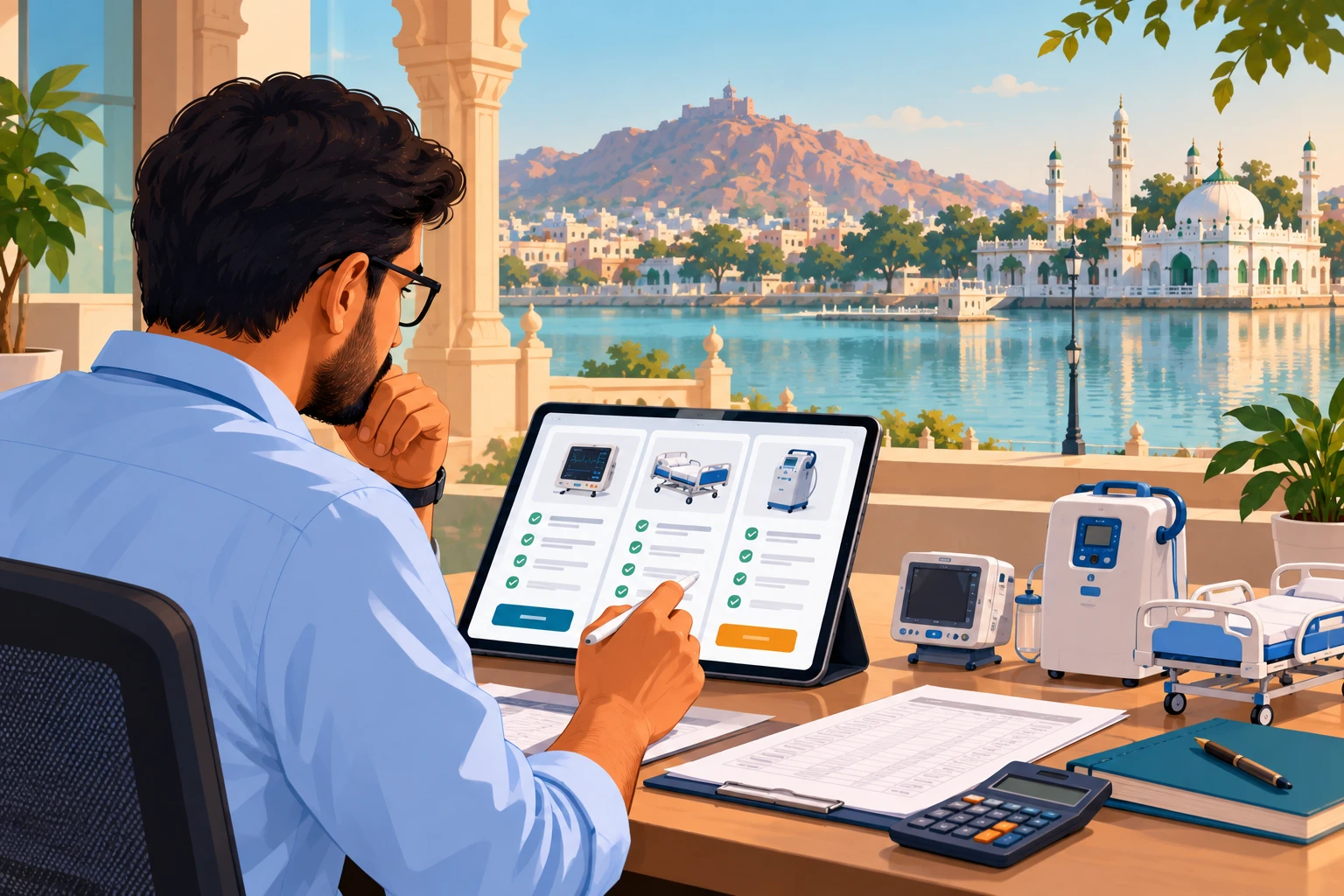
Top 20 Lab Equipment for Diagnostic Labs