 Medical Equipment
 Hospital Furniture
 Medical Disposables
 Rehabilitation
 Diagnostic & Labware
 Eyes & ENT
 Critical Care Equipment
 Urology
 Aesthetic & Dermatology Equipment
 Gastroenterology
 OT Equipment
By Devendra Sharma On 13-10-2026 at 3:41 pm
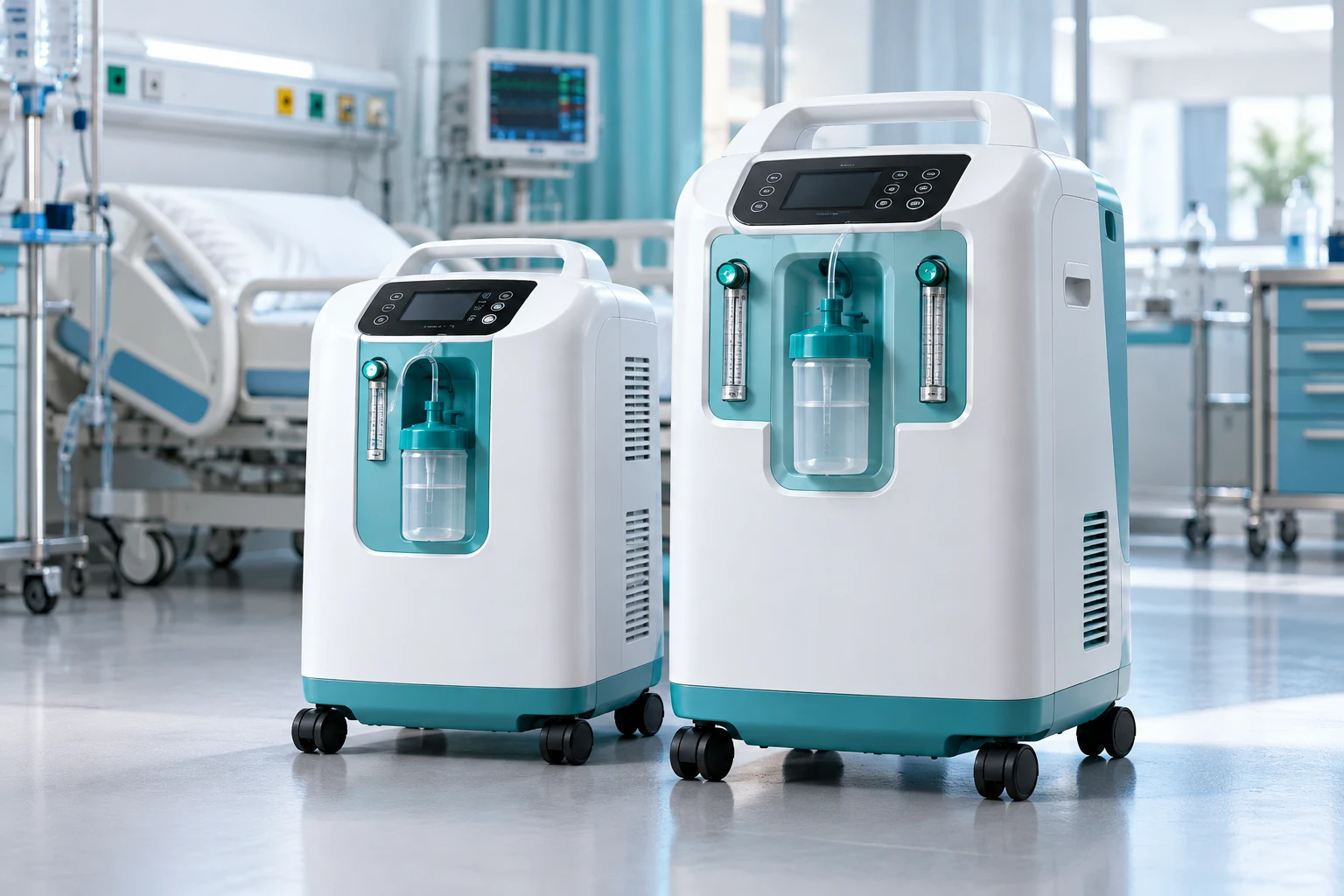
Oxygen Concentrator Price in India (2026): 5L vs 10L for Hospitals
A 5 litre oxygen concentrator is built for a single patient on low to moderate flow therapy, while a 10 litre unit is built for higher-flow therapy, larger patients, or the reliability margin a busy ward wants above what any one patient strictly needs. That one-line answer is where most comparisons stop, and it is also where most buyers get the decision wrong, because capacity alone does not tell you what a unit actually costs to run or how clinically useful it will be at the flow rate you intend to use. This guide covers 5L versus 10L in full, what actually drives price beyond the litre number, and how to choose the right capacity for your setting.
Key Takeaways
- Oxygen concentrator capacity is measured in litres per minute of continuous output, not a one-time tank size, and it draws from room air rather than running out mid-use like a cylinder.
- A 5L concentrator suits a single patient on moderate flow; a 10L model is built for higher-flow therapy or situations where reliability margin matters more, and some 10L units can serve two patients at a lower flow split.
- Purity percentage at your actual rated flow, not just the headline litre number, is what determines clinical usefulness, and purity typically drops as flow rate increases.
- Buying the wrong capacity for your setting is a common and avoidable mistake, more common in practice than buying the wrong brand.
- Filter replacement cost and continuous duty rating are recurring costs that matter more for a hospital's total cost of ownership than the upfront unit price.
What an Oxygen Concentrator Actually Does
An oxygen concentrator draws in ambient room air, passes it through a filtration and separation system that removes nitrogen and other gases, and delivers a continuous stream of concentrated oxygen to the patient through a nasal cannula or mask. Unlike an oxygen cylinder, which holds a fixed, depleting supply, a concentrator needs mains power but never runs out mid-use as long as power is available, which is exactly why hospitals increasingly keep it as a standing fixture in general wards rather than a backup-only device reserved for emergencies.
This distinction matters for planning. A cylinder-based oxygen supply requires tracking remaining volume and scheduling replacements, which is a logistics overhead every ward manages constantly. A concentrator removes that specific overhead for patients on moderate flow, though hospitals still typically keep cylinder backup for power-outage scenarios or very high-flow needs a concentrator cannot meet.
5L vs 10L: What the Number Actually Means
5 litre concentrators
Delivers up to 5 litres of oxygen per minute, suitable for a single patient on low to moderate flow therapy, which covers a large share of general ward oxygen support needs. This is the more common capacity for OPD, general ward and home-care-adjacent use, and it is usually the lower-cost option both to purchase and to run, since smaller compressors typically draw less power continuously.
10 litre concentrators
Delivers up to 10 litres per minute, suited to higher-flow therapy, larger patients, or situations where a facility wants a reliability margin above what a single patient strictly needs at any given moment. Many 10L units can also serve two patients simultaneously at a lower flow split, which is a genuine capacity advantage for a busy ward, not just a bigger number on the specification sheet. This flexibility is particularly useful in a facility managing fluctuating respiratory case loads, where a single larger unit can be reallocated between patients as needs change through the day.
Why the Difference Is Not Just About Device Size
A buyer comparing only the headline litre number misses that a 10L unit is not simply "two 5L units combined." The internal compressor, filtration stage and cooling system in a genuine 10L hospital-grade unit are engineered for sustained higher output, which is why 10L units cost meaningfully more than roughly double a 5L unit's price, not exactly double. This is worth understanding before assuming a 10L purchase is always the more "efficient" choice on a per-litre basis.
What Actually Drives the Price
Buyers often compare concentrators on litre capacity alone. A few other specifications matter just as much, sometimes more, for a hospital bulk order:
- Oxygen purity at rated flow: a concentrator's purity percentage typically drops as flow rate increases, so check the purity specification at the flow rate you will actually run, not only at the device's lowest setting where manufacturers often quote their best-case number.
- Continuous duty rating: a unit built for 24-hour continuous hospital use costs more than one rated for intermittent home use, and this difference matters directly for ward deployment, where a device running non-stop for weeks needs a compressor engineered for that duty cycle, not an occasional-use motor that will wear out under hospital conditions.
- Noise level: a meaningful comfort and clinical consideration in a shared ward where multiple units may run simultaneously near patients trying to rest, and a genuine differentiator between models at similar price points that rarely gets asked about upfront.
- Built-in alarms: power failure, low oxygen purity and filter-change alerts are standard on hospital-grade units and worth confirming rather than assuming, since a budget unit marketed for home use may lack the alarm redundancy a ward setting actually needs.
- Filter and maintenance cost: concentrators need periodic filter replacement, and this recurring cost should be factored into your comparison from the start, not treated as an afterthought once the unit is already in service.
- Warranty and service network: a longer warranty backed by an actual local service presence is worth more than a longer warranty with no one nearby to honour it.
Which Capacity Fits Which Setting
| Setting | Recommended capacity | Why |
|---|---|---|
| OPD / general ward, single patient moderate flow | 5L | Matches typical oxygen support needs without paying for unused capacity |
| ICU / HDU | 10L | Higher-flow therapy and reliability margin matter more in critical care |
| Facility running two patients off one unit | 10L | Allows a lower flow split across two patients where clinically appropriate |
| Backup unit for power-outage coverage | 5L, multiple units | Distributing backup capacity across several smaller units is often more practical than one large unit, and avoids a single point of failure |
| Step-down or recovery ward | 5L | Lower ongoing flow needs than acute care, where a 10L unit's extra capacity goes unused |
Total Cost of Ownership: Why the Upfront Price Is Only Part of the Picture
A bulk buyer comparing two concentrators on sticker price alone is comparing an incomplete number. Over a typical multi-year service life, filter replacements, any part replacements covered or not covered by warranty, and the electricity draw of running a unit continuously all add up, and a slightly cheaper unit with a shorter warranty or costlier replacement filters can end up being the more expensive choice by the second year. For a hospital ordering multiple units across several wards, it is worth asking any seller for an estimated filter replacement schedule and cost before comparing final quotes, rather than after the units are already in use.
Regulatory Classification: What CDSCO Oversight Means for Buyers
Oxygen concentrators fall under India's Medical Device Rules, 2017 as a regulated device category, which means legitimate units should carry CDSCO registration specific to the model you are buying, not a generic manufacturer-level claim. This matters more for oxygen concentrators than for some other equipment categories because the device directly delivers a therapeutic gas to a patient, and a unit with inconsistent purity output is a genuine safety concern, not just a performance shortfall. When comparing sellers, ask for the registration certificate for the exact model and batch you are ordering, and be cautious of a seller who can only provide a generic compliance statement without model-specific documentation.
Where Oxygen Concentrators Get Deployed Across a Hospital
Beyond the ICU and general ward use already covered, concentrators have found a place in several other hospital contexts worth planning for. Step-down and recovery wards, where patients transitioning out of acute care still need moderate oxygen support, are well served by 5L units. OPD observation areas, where a patient may need short-term oxygen support while awaiting transfer or further assessment, benefit from having a unit on hand rather than relying on cylinder logistics for occasional need. And facilities running satellite clinics or smaller attached units often deploy 5L concentrators specifically because they do not justify the infrastructure and logistics of cylinder supply chains for occasional use. Planning concentrator deployment across these settings, rather than buying only for the ICU and improvising elsewhere, tends to reduce both cost and the emergency cylinder orders that come from being under-equipped in a lower-acuity area.
Maintenance Basics Every Bulk Buyer Should Plan For
A concentrator's performance degrades gradually and often invisibly if maintenance is deferred, which is why building a maintenance schedule into your procurement decision matters as much as the initial specification comparison. Filters should be checked and replaced on the manufacturer's recommended schedule, not only when performance visibly drops, since a degrading filter reduces oxygen purity before it causes an obvious alarm or failure. The compressor's air intake should be kept clear of dust, which is a genuine consideration in several Rajasthan facilities given ambient dust levels, particularly in western districts. And alarm systems should be tested periodically as part of routine biomedical equipment checks, not left untested until an actual power failure or purity drop reveals whether they work. A seller who offers a structured annual maintenance contract, rather than only break-fix service, is generally the better choice for a facility running several units continuously.
What to Check Before You Order in Bulk
- Confirm purity percentage at your actual intended flow rate, not just the maximum rated flow, since this is the number that determines whether the device is clinically adequate for your typical patient.
- Ask for the continuous duty rating if the unit will run most of the day, not just during peak hours, and confirm this in writing rather than relying on a verbal assurance.
- Check CDSCO registration status for the specific model, oxygen concentrators are a device category regulators pay close attention to, and registration status can vary model to model even within the same manufacturer's range.
- Confirm filter replacement cost and availability before you order, this is a recurring cost most bulk buyers forget to budget for until the first replacement is due.
- Ask about noise level and alarm specifications if units will be placed in a shared ward, since these affect both patient comfort and clinical safety in ways a basic spec sheet comparison can miss.
- Compare against our wider ICU equipment checklist if you are setting up a new ward rather than restocking a single device, our ICU Setup Equipment Checklist covers the full list of equipment a critical care setup needs.
Frequently Asked Questions
Is a 10L concentrator always better than a 5L one?
Not necessarily. A 5L unit is adequate and more cost-efficient for moderate single-patient flow needs, and paying for 10L capacity you will not use is simply wasted budget. A 10L unit earns its higher price in higher-flow therapy or when serving more than one patient, not in every setting by default.
Does oxygen purity stay the same at every flow rate?
No, purity percentage for most concentrators decreases as flow rate increases. Always check the purity specification at the flow rate you intend to run, not the device's best-case number quoted at its lowest setting, since the gap between best-case and actual-use purity can be clinically meaningful.
How often do oxygen concentrator filters need replacing?
This varies by model and usage intensity, and manufacturers specify this differently across their ranges. Check the manufacturer's service manual for your specific unit, and build filter replacement into your maintenance schedule rather than waiting for performance to visibly drop, since a degraded filter reduces purity gradually and may not be obvious without routine checks.
Can one oxygen concentrator serve two patients at once?
Some 10L models can, at a lower flow split per patient, but this depends entirely on each patient's actual oxygen requirement and should be confirmed with the clinical team rather than assumed as a default capacity plan. Relying on split-flow capability as your primary ward strategy, rather than an occasional flexibility option, can leave you short if both patients' needs rise simultaneously.
Is a concentrator a full replacement for oxygen cylinders in a hospital?
Generally not entirely. Most hospitals keep cylinder backup for power-outage scenarios, since a concentrator requires mains power to function, and for flow rates beyond what even a 10L concentrator can reliably sustain. Concentrators reduce dependence on cylinder logistics for routine, moderate-flow use, but a complete oxygen supply strategy for most facilities still includes both.
Compare verified oxygen concentrator listings by capacity and purity rating. Register on HOSPkart to see actual rates before you order in bulk.

Author
Devendra Sharma
Related posts


15-4-2026
Top 20 Lab Equipment for Diagnostic Labs