 Medical Equipment
 Hospital Furniture
 Medical Disposables
 Rehabilitation
 Diagnostic & Labware
 Eyes & ENT
 Critical Care Equipment
 Urology
 Aesthetic & Dermatology Equipment
 Gastroenterology
 OT Equipment
By Devendra Sharma On 08-07-2026 at 1:23 pm
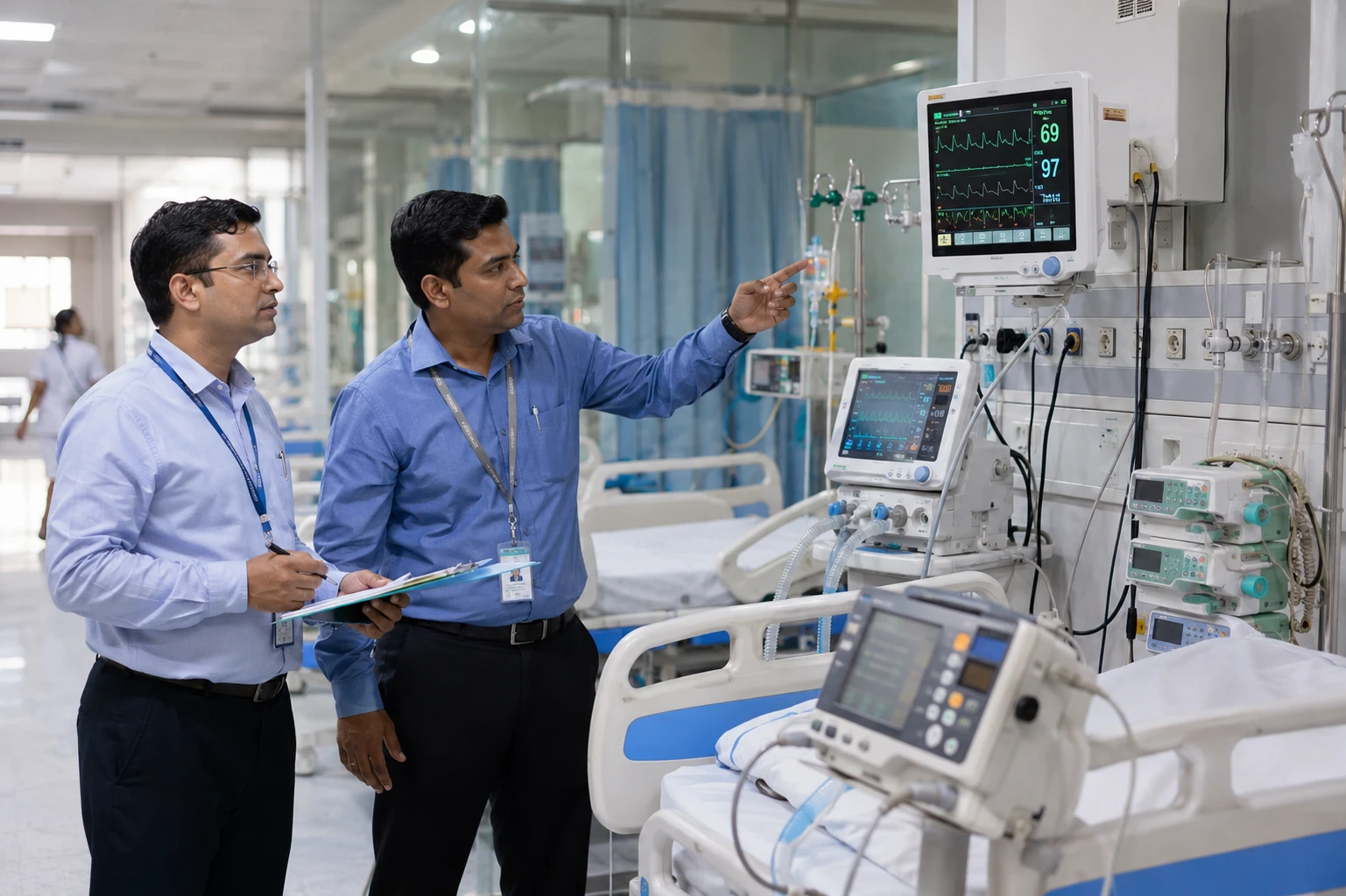
ICU Equipment Buying Guide for Hospitals in Jaipur (2026)
Every hospital administrator in Jaipur eventually hits the same wall: the ICU needs new equipment, budgets are tight, and the market is full of vendors making similar claims. Getting this decision right matters more than most procurement calls a hospital will make, because a ventilator that fails during a power cut or a monitor with a two-week service delay puts patients at direct risk. This guide breaks down what to actually check before buying, dealer by dealer, category by category, so the next ICU purchase order for your Jaipur facility holds up under real conditions.
What does a hospital need in place before opening a single ICU bed?
A functioning ICU rests on four equipment categories working together: respiratory support, continuous patient monitoring, a properly specified ICU bed, and an emergency response cart with a defibrillator on hand. Missing any one of these delays NABH readiness and leaves nursing staff working around gaps instead of patients.
Most Jaipur hospitals plan for three tiers of care rather than one flat ICU standard. A Level 1 unit handling stable post-op patients needs less than a Level 3 unit running ventilated cardiac or neuro cases. Getting this tier right upfront saves you from buying equipment that's either underpowered for your patient load or overspecified for a step-down ward.
The practical problem is rarely knowing what belongs on the list. It's finding one supplier who can deliver ventilators, beds, monitors and consumables together, on a timeline that doesn't stretch your opening date by months.
How should ICU equipment needs scale with hospital size?
A 20-bed ICU and a 100-bed multi-specialty ICU need the same equipment categories, but in very different quantities, redundancy levels and monitoring capacity. Getting that ratio wrong either strands capital in idle beds or leaves staff scrambling during a patient surge.
Smaller facilities generally do better with flexible, portable equipment: transport ventilators, mobile monitors, and beds that can convert between HDU and full ICU use. A 20-bed unit rarely justifies a dedicated central monitoring station, so bedside monitors with local alarms usually make more financial sense.
Larger multi-specialty ICUs need the opposite. Central monitoring stations, redundant ventilators in case one goes down for servicing, and backup power sized for the full ICU load stop being optional once bed count climbs past 40 or 50. Budget for at least one spare ventilator and one spare monitor per every ten beds, since equipment failure during peak occupancy is when a hospital's reputation actually gets tested.
Which ventilator features actually matter when picking a ventilator dealer in Jaipur?
A ventilator dealer in Jaipur worth signing with should offer both volume-controlled and pressure-controlled modes, a built-in humidifier, at least four hours of battery backup, and stocked spare parts within the city. Anything short of that turns a routine service call into an emergency patient transfer.
Rajasthan's summer power fluctuations are not a theoretical risk. Voltage drops and grid outages during peak load months happen often enough that battery backup isn't a nice-to-have line item. It's the difference between a ventilator staying online and a patient losing respiratory support mid-shift.
Ask any ventilator machine dealer for their average parts turnaround time in writing before you sign anything. A dealer quoting "within 24 hours" without a service center address in Jaipur is worth a second look before you commit.
How do you choose a reliable patient monitor supplier in Jaipur?
A patient monitor supplier in Jaipur worth working with sells multiparameter units that track ECG, SpO2, NIBP, respiratory rate and temperature on a single screen, with the option to link multiple bedside monitors to one central nursing station.
Central station compatibility matters more than most buyers realize at the quotation stage. A 12-bed ICU where nurses have to walk to each bedside to check vitals loses response time exactly when seconds count.
Alarm customization is the second thing worth testing, not just asking about. During a demo, have your own nursing staff set thresholds the way they would for a real patient and see how many false alarms trigger in an hour. A patient monitor that alarms constantly gets ignored, which defeats the entire purpose of the device.
What should hospitals look for in an ICU bed in Jaipur?
The choice between manual and electric ICU beds should be driven by the unit's ISCCM level classification, not by budget alone. A Level III ICU handling ventilated cardiac or neuro patients needs electric beds, while an HDU may function well with properly specified manual beds. Mixing both across a larger facility is usually the practical answer.
Electric ICU beds should come with CPR release, Trendelenburg positioning, side rails, and a built-in weighing scale as standard, not as paid add-ons. These features aren't cosmetic. They directly affect how fast staff can reposition a crashing patient or reweigh someone on fluid restriction without a transfer.
This isn't only a clinical question anymore. With NABH accreditation now serving as a near-prerequisite for empanelment under AB-PMJAY and most major insurance schemes, hospitals can no longer treat ICU bed procurement as a cost-led exercise. A bed that fails inspection standards can cost a facility its insurance empanelment, not just a patient complaint.
Check ICU bed specification sheets against your ICU's actual patient mix before ordering, not against a generic hospital furniture catalogue.
What other critical care equipment rounds out an ICU setup?
Beyond ventilators, monitors and beds, a working ICU needs infusion and syringe pumps for precise drug delivery, a suction machine for airway clearance, a defibrillator for cardiac emergencies, and a stocked crash cart with intubation supplies within arm's reach of every bed.
Syringe pumps handle small, high-precision doses like insulin or sedatives, while volumetric infusion pumps manage larger fluid volumes. Most ICUs need both, not one or the other, since a single patient can require both during the same admission.
Don't overlook the less glamorous line items. Nebulizers, oxygen concentrators, glucometers and a working autoclave for sterilization round out a list that looks unremarkable on paper but causes real problems when missing during an actual emergency. A defibrillator with a dead battery during a code is not a hypothetical failure mode; it happens often enough to be a standard audit item on any serious ICU checklist.
How much does ICU equipment setup cost for a hospital in Jaipur?
There's no single number here, because cost depends on bed count, new versus refurbished stock, and how many separate vendors you're buying from. What stays consistent is that buying piecemeal from a dozen dealers almost always costs more than consolidating the order with fewer, larger vendors.
For context on the scale of ICU spending, the average ICU charges in a private hospital in India can range between INR 15,000 and INR 30,000 per day, and equipment cost is one of the line items baked into that daily rate. Getting procurement right on the front end has a direct, compounding effect on what a hospital can charge and still stay competitive against nearby facilities.
Hospitals that consolidate procurement through a single B2B channel rather than negotiating with each manufacturer separately typically report savings in the 20 to 30 percent range on bulk equipment orders. Group demand gives buyers real price leverage that a single hospital rarely has on its own.
What certifications should an ICU equipment supplier in Jaipur carry?
Every device on your ICU floor should carry CDSCO registration under the Medical Devices Rules, since the Central Drugs Standard Control Organization, operating under the Ministry of Health and Family Welfare, oversees India's medical device regulations. Ask for this documentation before the equipment arrives, not after.
ISO 13485 on the manufacturing side and CE marking for imported devices are the next two checks. A supplier who can't produce these on request within a day probably doesn't have them readily on file, which tells you something about how they'll handle a warranty claim later.
Keep a folder of compliance documents per device, updated every time you replace or upgrade equipment. NABH inspectors ask for this during accreditation visits, and scrambling to find paperwork during a surprise audit is its own kind of stress nobody needs.
Why does after-sales support matter more than the purchase price tag?
The cheapest quote on paper often becomes the most expensive equipment in practice once downtime, technician travel time, and parts shipped in from outside Rajasthan get factored in. After-sales support, not the sticker price, decides whether equipment stays running through its full working life.
Ask for a written annual maintenance contract (AMC) before you sign the purchase order, not after. A supplier who treats AMC terms as an afterthought during negotiation usually treats service calls the same way once the sale is closed.
Training matters just as much as the hardware. New ventilators and monitors often ship with features nursing staff never end up using simply because nobody walked them through it at installation. Ask suppliers to include hands-on training for at least one full shift cycle as part of the deal, not a one-hour handover session.
How do you evaluate an ICU equipment supplier in Jaipur before signing?
Run every serious quote through the same four checks: certifications on file, after-sales service response time in writing, spare parts availability locally, and total cost of ownership rather than sticker price alone. A cheaper ventilator that needs a part flown in from another state isn't actually cheaper.
This is where a marketplace approach starts to make more sense than chasing individual dealers one category at a time. HOSPkart, a B2B medical equipment marketplace headquartered in Jaipur, connects hospitals with verified manufacturers across ventilators, patient monitors, ICU beds, infusion pumps and hospital furniture under one platform rather than a dozen separate vendor relationships. For a Jaipur hospital trying to standardise ICU procurement instead of piecing it together department by department, working with a single verified sourcing channel based in the same city cuts down the back-and-forth considerably, and buyers can compare specifications and pricing across critical care equipment categories before committing to a purchase order.
Ask for references from other Jaipur or Rajasthan hospitals the supplier has already equipped, not just a generic client list. A supplier reluctant to share a reference for the exact ventilator model you're considering is worth a second look before you commit budget to them.
Frequently asked questions
What is the cost of ICU equipment setup for a new hospital?
Cost varies widely with bed count and new versus refurbished equipment, but consolidating orders through one supplier typically brings 20 to 30 percent savings over buying piecemeal.
What are the essential equipment items required in every ICU?
Every ICU needs ventilators, multiparameter patient monitors, ICU beds, infusion and syringe pumps, a defibrillator, and a suction machine at minimum.
How do I verify if an ICU equipment supplier in Jaipur is CDSCO compliant?
Ask the supplier for CDSCO registration certificates for each device model and cross-check the registration number on the CDSCO portal.
Can hospitals in Jaipur buy ICU equipment in bulk to save money?
Yes, group or bulk procurement through a B2B marketplace generally costs less than negotiating separately with each manufacturer.
Is NABH certification mandatory for ICU beds in India?
NABH certification isn't legally mandatory, but it's a practical requirement for hospitals seeking empanelment under AB-PMJAY and most major insurance schemes.

Author
Devendra Sharma
Related posts


15-4-2026
Top 20 Lab Equipment for Diagnostic Labs