
 Medical Equipment
 Hospital Furniture
 Medical Disposables
 Rehabilitation
 Diagnostic & Labware
 Eyes & ENT
 Critical Care Equipment
 Urology
 Aesthetic & Dermatology Equipment
 Gastroenterology
 OT Equipment
By Devendra Sharma On 13-07-2026 at 5:00 pm
Types of Hospital Beds & Their Uses Explained
What Are the Types of Hospital Beds, and Which One Fits Your Ward?
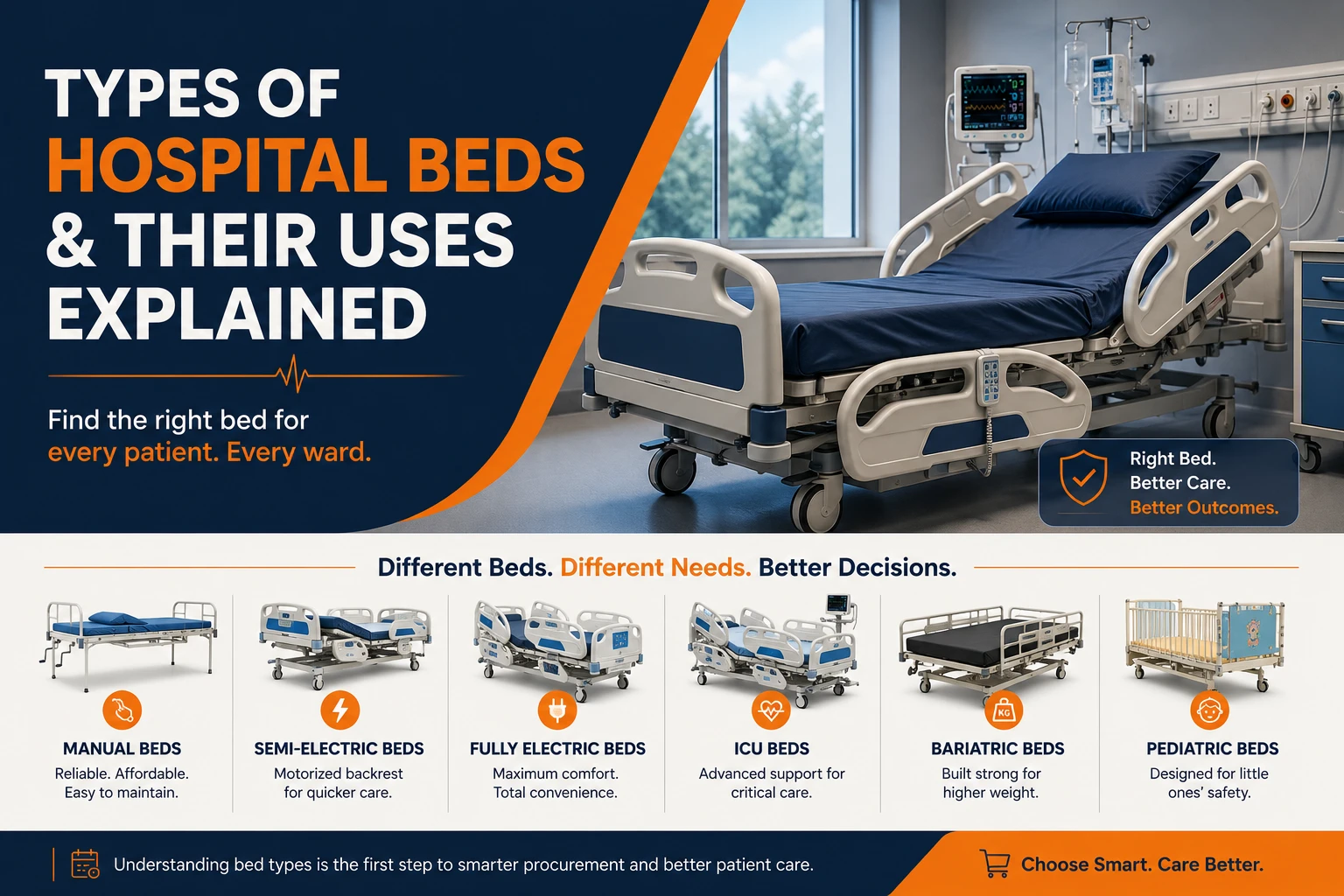
The types of hospital beds on the market fall into two overlapping categories: how they adjust (manual, semi-electric, fully electric) and what they are built for (general ward, ICU, bariatric, pediatric, psychiatric, obstetric). Get the category wrong and a facility either overpays for motors nobody uses or under-equips a ward that needs powered positioning. We have sat across the table from enough hospital purchase committees to know the confusion is rarely about names, it is about matching a bed's function to a patient's actual condition. This guide walks through every major type of hospital bed used in Indian healthcare settings today, from manual Fowler frames to full-electric ICU beds, so procurement gets it right the first time.
How Do Hospital Beds Differ by the Way They Adjust?
Among the types of hospital beds available, adjustment mechanism is the most basic dividing line. Every bed sits somewhere on a three-point scale: manual, adjusted with hand cranks; semi-electric, with motorized backrest and knee-rest but a manual height crank; and fully electric, where a motor handles backrest, knee-rest, and overall height, usually from a handheld or nurse-side control panel. The mechanism decides both the upfront cost and how much staff time each repositioning eats up.
In our experience helping nursing homes and small hospitals budget for a new ward, manual frames still show up as the default line item on tenders, not because staff prefer cranking a handle, but because government and public-hospital procurement is priced heavily on unit cost. Ken Research's market analysis backs this pattern: manual beds hold the largest share of India's hospital bed market largely on affordability and suitability for rural and tier-2 facilities, where low maintenance cost and simple operation matter more than convenience features. Semi-electric beds sit in the middle, common in private general wards where nurses need quick backrest changes without the price tag of a fully powered frame. Fully electric beds concentrate in ICUs, post-operative recovery, and bariatric care, anywhere a patient's position needs to change often and quickly.
What Is the Difference Between a Fowler Bed and a Semi-Fowler Bed?
A Fowler bed raises the backrest anywhere from 45 to 90 degrees and also lifts the knee section, giving the patient a near-sitting posture for meals, breathing support, or recovery from cardiac and abdominal procedures. A semi-Fowler bed raises only the backrest, usually to a lower angle, and leaves out the knee-rest function entirely.
Geeken Healthcare's comparison of the two frames confirms this: full backrest-plus-knee elevation defines a Fowler bed, while a semi-Fowler bed offers partial backrest lift only. Gitamediquip's spec comparison goes further and notes that knee rest is really the only functional gap between the two designs. There is a clinical reason this distinction matters beyond comfort. Federal guidance compiled by the U.S. Agency for Healthcare Research and Quality points to CDC recommendations that ventilated patients be kept at a 30 to 45 degree semi-recumbent angle specifically to cut the risk of ventilator-associated pneumonia, which is precisely the range a Fowler bed is designed to hold accurately. In conversations with ICU in-charges across north Indian hospitals, Fowler positioning comes up constantly for post-surgical and respiratory patients, while semi-Fowler beds get requested for general wards where someone mostly needs to sit up for meals or visitors.
How Is an ICU Bed Different From a Regular Ward Bed?
An ICU bed is built for a patient whose condition can shift within the hour: full electric adjustability at every joint, Trendelenburg and reverse-Trendelenburg tilt for shock and reflux management, a reinforced frame, side-rail-mounted controls, and mounting points for monitors, IV poles, and traction hardware. A standard Fowler or ward bed handles routine positioning but is not engineered for that pace of intervention.
Comparative reviews of ICU-grade beds describe reinforced frames, integrated weight scales, and built-in monitoring interfaces as the features separating them from routine ward stock, plus electric height and tilt control a caregiver can trigger in seconds rather than minutes. That speed matters clinically: Trendelenburg lowers the head below the feet to support circulation during shock, while reverse-Trendelenburg raises the head to lower aspiration risk. Pressure management is just as central to the design brief. The National Pressure Injury Advisory Panel puts the share of critical-care patients who develop a pressure injury during their stay at up to 40 percent, which is why ICU beds pair powered positioning with pressure-redistributing surfaces rather than a standard foam mattress. Every ICU procurement conversation we have sat in on eventually comes back to two questions: can the bed reach Trendelenburg fast enough during a code, and does the mattress interface actually reduce pressure points for a patient who may not move on their own for days.
What Are the Main Uses of an Electric Hospital Bed in a Hospital Setting?
Electric hospital beds earn their cost in three places: faster repositioning during emergencies, safer patient handling for nursing staff, and better compliance with clinical positioning protocols that would otherwise depend on someone remembering to crank a handle on schedule. They see the heaviest use in ICUs, post-operative recovery, bariatric wards, and any unit where patients cannot reposition themselves.
The clinical case is well documented on both ends. CDC guidance reviewed by the Agency for Healthcare Research and Quality recommends holding ventilated patients at a semi-recumbent 30 to 45 degree angle to reduce ventilator-associated pneumonia risk, a position an electric bed holds precisely at the touch of a button. On the skin-integrity side, a large international pressure-injury prevalence study found routine repositioning lowers the odds of a hospital-acquired pressure injury by roughly 14 percent, and an electric bed removes the friction of manually cranking a heavy frame every two hours on a busy night shift. There is a staff-safety angle too: occupational health researchers have long flagged manual patient transfers as a leading cause of musculoskeletal injury among caregivers and nursing staff, a risk electric height adjustment reduces by letting staff raise the bed to a safe working height instead of bending over it. Nursing staff we have spoken with during hospital walkthroughs consistently name height adjustment, not the backrest motor, as the feature they miss most on manual beds, simply because it is the motion they repeat dozens of times a shift.
Which Specialty Hospital Beds Exist for Specific Patients?
Beyond the Fowler, semi-Fowler, and ICU line, hospitals stock a handful of beds built around a specific patient group rather than a specific clinical procedure:
Bariatric beds — reinforced frames and wider decks for higher weight capacities.
Pediatric beds — scaled down to a child's frame, often with less clinical-feeling design.
Psychiatric beds — built to remove ligature points and reduce entrapment risk.
Obstetric or delivery beds — configured for labor and delivery rather than general recovery.
Attendant or plain beds — basic, low-cost units for caregivers and stable, low-acuity patients.
Home-care equipment guides put bariatric weight capacities at 450 to 1,000 pounds, built into reinforced frames rather than just a wider mattress, while hospital furniture manufacturers describe pediatric beds as scaled down specifically to feel less clinical to a young patient. In practice, orders for these two categories come from very different buyers, orthopedic and bariatric surgery units on one side, maternity or children's hospitals on the other, which is a large part of why “specialty bed” means something different depending on which department is asking. Psychiatric and attendant beds rarely make it into general comparison articles, yet they are routine line items for any facility running a full-service inpatient block.
What Features Should You Check Before Buying a Hospital Bed?
Beyond the power mechanism, six features actually decide whether a bed holds up past year one:
Weight capacity — rated for the heaviest patient the ward realistically admits, not just the average case.
Side-rail design — assessed against known entrapment gap zones, not just “rails present or absent.”
Mattress compatibility — whether the frame accepts pressure-redistributing or air mattresses if acuity rises later.
Frame material — CRCA or CECA steel with epoxy powder coating for corrosion resistance under repeated cleaning.
Castor and lock quality — the component most likely to fail first under daily ward use.
Entrapment safety — verified against recognized dimensional guidance, not assumed from the rail alone.
Entrapment safety is the one buyers most often skip. The U.S. FDA, working with the Hospital Bed Safety Workgroup, publishes dimensional guidance mapping specific gap zones between rail, mattress, and frame where a patient can become trapped, and recommends assessing beds against those zones rather than assuming a rail is safe by default. Indian manufacturer spec sheets converge on CRCA or CECA steel with epoxy powder coating for the same reason durability shows up on this list: it is what survives repeated disinfectant cycles without corroding. When we walk a facilities manager through a spec sheet, frame material and castor lock quality get glossed over far more often than backrest angle or motor wattage, yet they decide whether a bed still rolls smoothly two years into daily ward use.
How Do You Choose the Right Hospital Bed Type for Your Ward or Budget?
Choosing among the types of hospital beds available comes down to three questions:
How acute is the patient population this bed will serve?
How many hours a day will staff spend adjusting it?
What can the ward realistically maintain over its service life?
A general ward with ambulatory, lower-acuity patients rarely needs more than a manual or semi-electric Fowler bed. An ICU, post-operative, or bariatric unit almost always justifies the added cost of full electric adjustability.
The scale of demand behind this decision is not small. Industry research on India's hospital sector points to a shortfall of roughly 2.4 million beds against the country's recommended bed-to-population ratio, a gap that public and private facilities are both racing to close as budgets expand. Within that buildout, ward-care beds continue to hold the largest functional share because of their versatility and lower cost across general inpatient settings, while electric and ICU segments grow faster as critical-care capacity expands. Across the different types of hospital beds covered here, the underlying pattern holds steady: match the bed to the acuity of the patient it will serve rather than to the longest feature list, and the procurement decision gets considerably simpler.
Frequently Asked Questions
What are the main types of hospital beds?
The main types split by adjustment mechanism into manual, semi-electric, and fully electric beds, and by clinical purpose into Fowler, semi-Fowler, ICU, bariatric, pediatric, psychiatric, and obstetric beds. Most hospitals stock a mix of both classifications, choosing the mechanism based on budget and the purpose based on which ward or patient group the bed will actually serve.
What is the difference between an ICU bed and a Fowler bed?
An ICU bed adds full electric control, Trendelenburg tilt, a reinforced frame, and monitoring mounts for critically ill patients whose condition can change quickly. A Fowler bed only raises the backrest and knees to 45 to 90 degrees for general positioning, recovery, and comfort, without the tilt functions or reinforced build an ICU setting requires.
What is an electric hospital bed used for?
Electric hospital beds are used wherever fast, precise repositioning matters: ICUs, post-operative recovery, bariatric care, and wards with immobile patients. They support clinical protocols like semi-recumbent positioning for ventilated patients and frequent repositioning for pressure-injury prevention, while reducing the physical strain on nursing staff during routine transfers.
Which hospital bed is best for a general ward?
A manual or semi-electric Fowler bed suits most general wards, where patients are ambulatory or only need occasional backrest adjustment. These options cost less to purchase and maintain than fully electric frames, which are better reserved for ICU, post-operative, and bariatric units with higher acuity patients.
How much weight can a bariatric hospital bed hold?
Bariatric hospital beds typically carry weight capacities between 450 and 1,000 pounds, roughly 200 to 450 kilograms, depending on the model and frame construction. They also come with wider deck sizes than standard beds, so the patient has adequate surface area rather than just a higher weight rating.
Do hospital beds need any safety certification before purchase?
Facilities should confirm a bed has been assessed against recognized entrapment-safety guidance, such as the dimensional criteria published by the FDA and the Hospital Bed Safety Workgroup, along with relevant frame and electrical safety standards. Asking a supplier for this documentation upfront avoids retrofitting safety fixes after the

Author
Devendra Sharma
Related posts



15-4-2026
Top 20 Lab Equipment for Diagnostic Labs