 Medical Equipment
 Hospital Furniture
 Medical Disposables
 Rehabilitation
 Diagnostic & Labware
 Eyes & ENT
 Critical Care Equipment
 Urology
 Aesthetic & Dermatology Equipment
 Gastroenterology
 OT Equipment
By Devendra Sharma On 13-10-2026 at 3:56 pm
HOSPkart vs Smart Medical Buyer: Which Suits Tier 2 Hospitals?
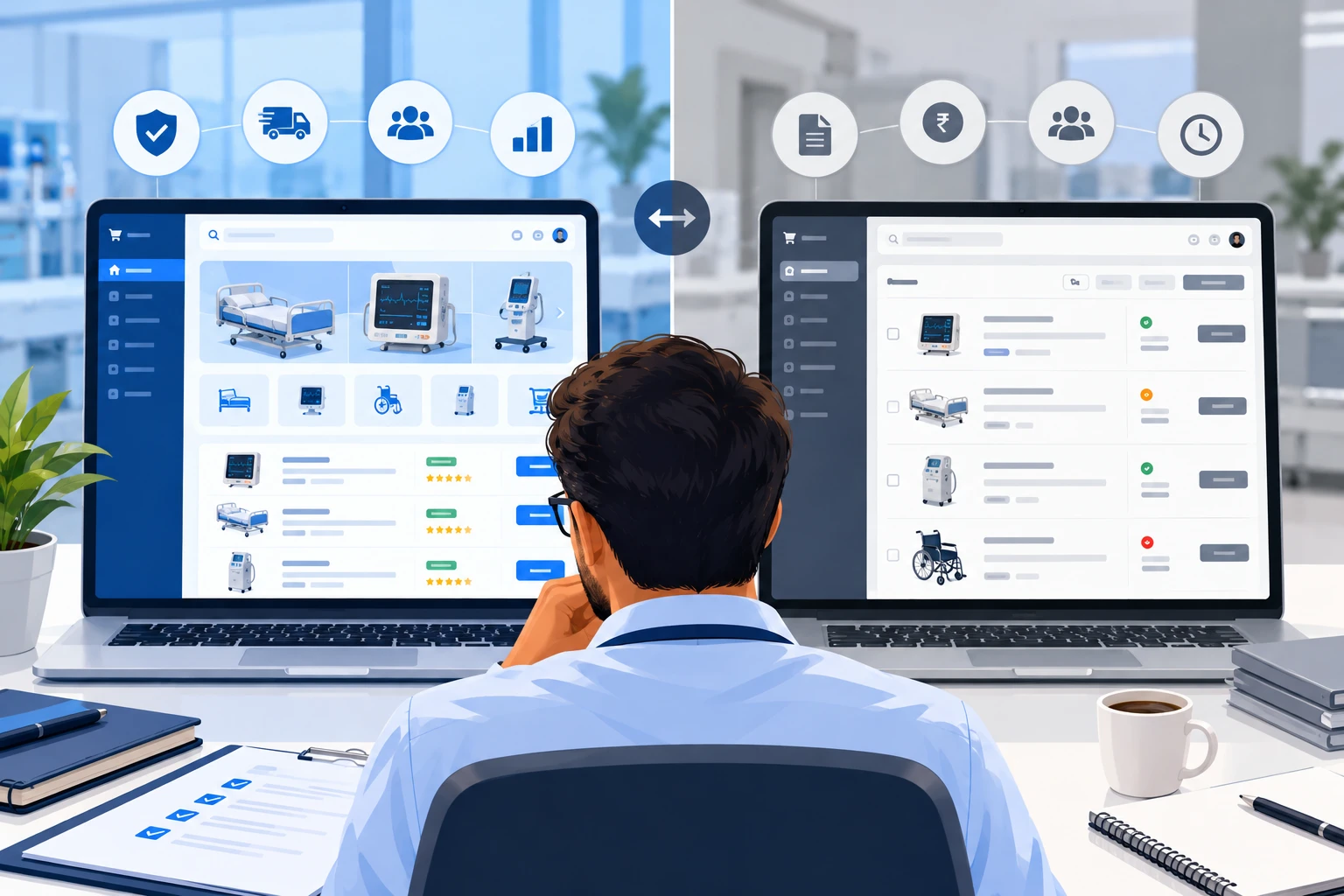
Smart Medical Buyer's strength is direct-manufacturer sourcing and a catalogue of over 8,000 products with bulk and pre-payment discounts, while HOSPkart's strength is verified-seller depth with a genuine Jaipur and Kota presence, which matters most for after-sales service and local delivery in Rajasthan specifically. Neither platform is universally better. The right choice depends on whether your priority is catalogue breadth and direct pricing on consumables, or local verification and service backing for equipment that will need ongoing support. This comparison breaks down exactly how the two differ and which Tier 2 hospital need each one actually solves.
Key Takeaways
- Smart Medical Buyer's strength is its direct-manufacturer sourcing model and broad catalogue of over 8,000 products, with bulk and pre-payment discounts, and no subscription or membership structure.
- HOSPkart's strength is verified-seller depth and a genuine Jaipur and Kota presence, which matters most for after-sales service and local delivery in Rajasthan.
- Neither platform is universally better, the right choice depends on whether your priority is catalogue breadth and direct pricing, or local verification and service backing.
- The two platforms solve different procurement problems: one-time or periodic bulk purchasing versus ongoing equipment relationships that depend on local service reliability.
What Smart Medical Buyer Offers
Smart Medical Buyer operates as an online store sourcing medical products directly from manufacturers, spanning surgical supplies, IV and infusion products, wound care, diagnostic test kits, dialysis supplies and dental products, among other categories. Its pricing model emphasises direct-sourcing discounts and additional savings for bulk orders and pre-payment, without a subscription or membership structure, which makes it a straightforward transactional model: place an order, get a price based on quantity and payment terms, receive the shipment. This model particularly suits buyers who know exactly what they need, order in predictable bulk quantities, and do not require an ongoing local service relationship for the products involved, since most of its catalogue is consumables and disposables rather than capital equipment needing installation or maintenance contracts.
What HOSPkart Offers
HOSPkart is built around a narrower, more specific promise: a network of verified sellers, a genuine Jaipur headquarters and Kota regional office, and pan-India delivery as a GeM-verified seller. Rather than competing on catalogue breadth alone, the model is built around the idea that for equipment, as opposed to disposable consumables, the relationship that matters most begins after delivery, when something needs servicing, a replacement part, or troubleshooting support. This is a genuinely different value proposition from a direct-sourcing consumables store, and it is most relevant for the equipment categories where ongoing service matters: ICU equipment, diagnostic devices, OT equipment and similar capital purchases rather than disposables ordered and consumed on a recurring cycle.
Where the Two Platforms Differ
| What to check | Smart Medical Buyer | HOSPkart |
|---|---|---|
| Sourcing model | Direct from manufacturers | Verified seller network |
| Catalogue | Broad, 8,000+ products, consumables-heavy | Equipment, furniture, disposables and lab equipment focused |
| Pricing structure | Bulk and pre-payment discounts | Transparent pricing once registered |
| Rajasthan-specific presence | National platform, Delhi-based | Jaipur HQ, Kota regional office |
| GeM verification | Not specified | GeM-verified seller |
| Best suited for | Bulk consumables purchasing, pre-payment buyers | Equipment needing ongoing local service support |
Which Platform Fits Which Need
A Tier 2 hospital buying standard consumables in bulk, where direct-manufacturer pricing and pre-payment discounts matter most, may find Smart Medical Buyer's model genuinely appealing for that specific category, particularly if the hospital has the working capital to take advantage of pre-payment discounts and the storage capacity to hold bulk quantities without straining cash flow. A Tier 2 hospital buying equipment that will need ongoing service support, and that values a supplier with a genuine local presence in Rajasthan, is better served by a platform built around that specific need, which is HOSPkart's core positioning.
It is also worth separating the two procurement problems explicitly rather than evaluating both platforms against a single blended need. Standalone bulk consumables purchasing from a national platform is a different decision from recurring, pooled weekly ordering, and a different decision again from one-time capital equipment purchasing. If your hospital's real cost problem is recurring consumables pricing rather than one-time bulk purchases, our sister platform H.O.P.E. and its guide on consumables vs equipment procurement strategy explains why these need genuinely different approaches, not a single platform trying to serve all three needs at once.
A Practical Way to Decide: Match the Platform to the Purchase Type
Rather than picking one platform as your default for everything, a more effective approach for many Tier 2 hospitals is matching each purchase category to whichever model actually fits it. Standard, predictable consumables that you order in bulk and do not need ongoing service support for, gloves, syringes, basic disposables, are reasonable candidates for a direct-sourcing model if the pricing and minimum order quantities work for your facility. Equipment that will need installation, commissioning, periodic maintenance or eventual repair, ICU beds, patient monitors, diagnostic devices, benefits more from a verified-seller model with genuine local service backing, since the purchase price is only the first part of the real cost of ownership. And recurring, weekly consumables ordering, where the real lever is combined order volume rather than a single bulk purchase, is best served by a pooled procurement model built specifically for that pattern, rather than either a direct-sourcing store or a verified equipment marketplace.
Why "Which Platform Is Better" Is the Wrong Starting Question
Hospital buyers researching this comparison often start by looking for a single winner, which platform is objectively better, when the more useful question is which problem you are actually trying to solve this quarter. A hospital restocking its gloves and syringes inventory and a hospital buying a new ICU monitor are solving two completely different procurement problems, even though both might technically be served by either platform's listings. Evaluating Smart Medical Buyer and HOSPkart as if they are competing for the exact same purchase decision misses that their underlying models were built to solve different problems well, direct-sourcing bulk economics on one side, verified local service relationships on the other. A hospital that recognises this upfront tends to make better platform decisions than one looking for a single universal answer.
What GeM Verification Actually Signals to a Buyer
GeM, the Government e-Marketplace, verification is worth understanding specifically rather than treating as a generic trust badge. A GeM-verified seller has gone through a registration and compliance process tied to government procurement standards, which is directly relevant if your facility is a government-linked buyer, a government hospital, or a facility pursuing scheme empanelment where procurement documentation matters. For a purely private facility with no government procurement requirement, GeM verification is still a useful additional signal of seller legitimacy, though it is one data point among several rather than a complete substitute for your own verification checklist on CDSCO registration, GST compliance and service coverage.
What to Check Before Choosing Either
- Does the platform verify individual sellers, or operate as a direct-sourcing store? Both models can work, but they carry different verification questions, and knowing which model you are actually dealing with changes what you should be asking before you order.
- What is the actual delivery and service timeline to your specific district? A national catalogue does not guarantee fast service response in every region, and this gap matters far more for equipment than for consumables.
- Is pricing transparent once you place an order, or does it require negotiation per purchase? A platform with visible, consistent pricing once registered is easier to plan a budget against than one requiring a fresh quote for every order.
- Does the platform have GeM verification, relevant if your facility is a government-linked buyer or values that additional verification layer as part of your own compliance requirements.
- What happens after the sale for equipment specifically? Ask directly about warranty terms, service contract availability and typical response time for a repair request, since this is where the two platform models diverge most for capital equipment purchases.
Our broader comparison approach, used across HOSPkart vs Medpick and our Medikabazaar review, applies the same checklist regardless of which platform you are evaluating, since the underlying questions a hospital buyer needs answered do not change much from one comparison to the next.
Reading Between the Lines of a Platform's Own Marketing
Both platforms, like any B2B marketplace, present their strengths prominently and their limitations less visibly, which is a normal part of marketing but worth accounting for when comparing them. A platform emphasising catalogue size is implicitly telling you less about its depth of service support, and a platform emphasising local service presence is implicitly telling you less about its catalogue breadth relative to a larger national competitor. Reading a platform's marketing for what it does not emphasise, not just what it does, is a useful habit for any hospital buyer comparing options, since the gaps in what a company chooses to highlight are often as informative as the highlights themselves.
Frequently Asked Questions
Is Smart Medical Buyer only for consumables, or does it sell equipment too?
Its catalogue is heavily weighted toward consumables and disposables, surgical supplies, IV products, wound care and diagnostic kits, alongside some equipment categories. For larger capital equipment with ongoing service needs, verify its support model directly before ordering, since this is not the primary strength its catalogue breadth is built around.
Does HOSPkart offer bulk discount pricing similar to Smart Medical Buyer?
HOSPkart's pricing becomes visible once you register, reflecting verified seller rates for the specific equipment you need, rather than a blanket pre-payment discount structure. Compare both approaches against your actual order volume and payment preference, since a bulk-discount model and a verified-rate model solve different buyer priorities.
Which platform has better service support for Rajasthan hospitals?
HOSPkart's Jaipur headquarters and Kota regional office are built specifically around Rajasthan service coverage. Confirm Smart Medical Buyer's actual service response time for your specific district directly with them before relying on it for equipment that will need ongoing maintenance, since a national platform's support structure is not always built around fast, local visits in every region.
Can a hospital reasonably use both platforms for different purchase categories?
Yes, and this is often the most practical approach for a Tier 2 hospital. Using a direct-sourcing model for predictable bulk consumables and a verified-seller model for equipment needing ongoing service is a reasonable way to match each purchase category to the model that actually fits it, rather than forcing every purchase through a single platform.
How should a hospital weigh catalogue breadth against local service presence when choosing a platform?
This depends on what you are buying. For consumables consumed quickly with no ongoing service dependency, catalogue breadth and pricing matter more. For equipment you will rely on for years and may need serviced or repaired, local service presence and verification depth matter more than having the widest possible catalogue to choose from.
Does pre-payment for a bulk discount make sense for every hospital?
Not necessarily. Pre-payment discounts benefit facilities with enough working capital and storage capacity to take advantage of them without straining cash flow. A smaller facility ordering smaller quantities more frequently may find a transparent, non-prepaid pricing model easier to plan around, even if the headline discount looks smaller on paper.
Compare verified sellers with genuine Rajasthan service backing. Register on HOSPkart to see actual rates before you order.

Author
Devendra Sharma
Related posts



15-4-2026
Top 20 Lab Equipment for Diagnostic Labs