 Medical Equipment
 Hospital Furniture
 Medical Disposables
 Rehabilitation
 Diagnostic & Labware
 Eyes & ENT
 Critical Care Equipment
 Urology
 Aesthetic & Dermatology Equipment
 Gastroenterology
 OT Equipment
By Devendra Sharma On 13-10-2026 at 3:46 pm
Defibrillator Types and Price in India (2026): AED vs Manual for Hospitals
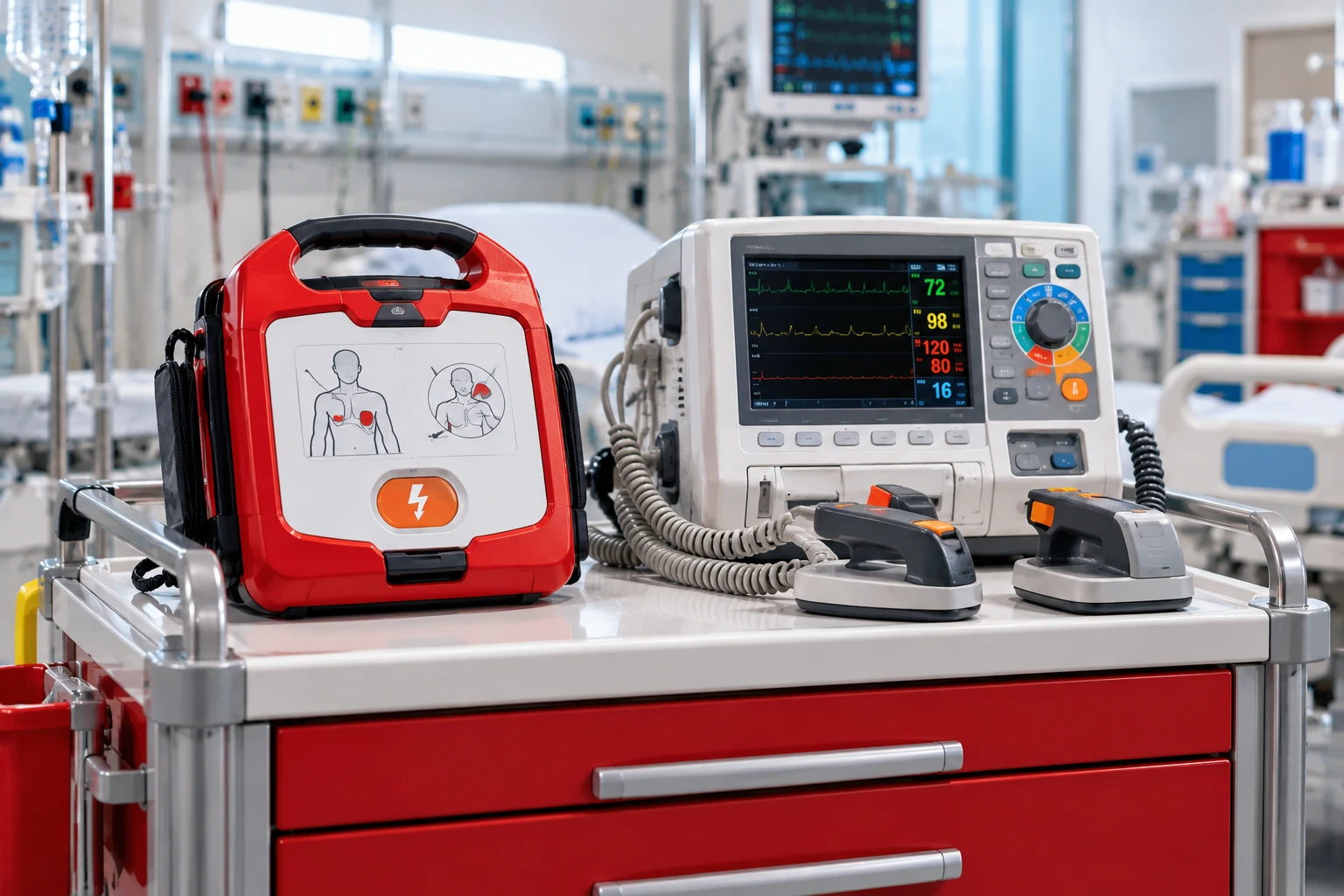
An AED is built for use by any trained responder, including non-clinical staff, and automatically analyses the heart rhythm before advising or delivering a shock, while a manual defibrillator requires a trained clinician to read the rhythm and decide when to shock, trading automation for full clinical control. Most hospitals need both, not one or the other, and the choice is really about where in the facility each type belongs. This guide covers the real difference between the two, what actually drives price beyond the basic type, and how to match the right device to the right location in your hospital.
Key Takeaways
- An AED is designed for use by any trained responder, including non-clinical staff, and automatically analyses the heart rhythm before advising or delivering a shock.
- A manual defibrillator requires a trained clinician to read the rhythm and decide when to shock, offering more clinical control at the cost of needing specific expertise present at the moment of use.
- Most hospitals need both, an AED for common areas and general ward response, and a manual or advanced defibrillator for the ICU, emergency department and OT.
- Biphasic defibrillators are now the standard technology; confirm this specification rather than assuming it on any device you compare, since monophasic units are increasingly outdated.
- Battery and electrode pad shelf life is a genuine recurring cost that is easy to overlook on a device that may sit unused for months between emergencies.
AED vs Manual: The Core Difference
Automated External Defibrillator (AED)
An AED analyses the patient's heart rhythm automatically and either advises the responder to deliver a shock or does so with minimal input, depending on the specific model. It is designed to be used safely by trained non-clinical staff, security personnel, reception staff, general ward attendants, which is exactly why hospitals place them in common areas, corridors and reception zones, not just clinical areas where a trained clinician is already present. The device's own internal logic is built to guide an untrained or minimally trained user through the process safely, which is the entire point of the category.
Manual defibrillator
A manual defibrillator requires a clinician to interpret the cardiac rhythm displayed on the device's screen and decide when and how to deliver a shock, with full control over energy level, timing and waveform settings. This is the right tool wherever a trained clinician is reliably present and the clinical situation may call for more nuanced response than an AED's automated logic provides, typically the ICU, emergency department and operation theatre, where clinical staff are already on hand and the acuity of the patients being treated justifies the added control a manual device offers.
Where Each Type Belongs in a Hospital
| Location | Recommended type | Why |
|---|---|---|
| Reception, corridors, general common areas | AED | Usable by non-clinical staff in the first critical minutes before a clinical team arrives |
| General ward | AED, or manual if nursing staff are trained | Depends on staff training level and how quickly a clinical response team can reach the ward |
| Emergency department | Manual (often biphasic, with advanced features) | Clinical team present and situation may need more nuanced control than automated response |
| ICU / OT | Manual (often biphasic, with advanced features) | Highest-acuity setting, full clinical control is a requirement, not a convenience |
| Ambulance | Manual or AED-manual hybrid, portable and rugged | Needs to withstand movement and function reliably without mains power |
What Actually Moves the Price
- Biphasic vs monophasic waveform technology: biphasic is now the clinical standard, generally requiring lower energy for equivalent effect and considered safer; confirm this specification directly rather than assuming every listed device is biphasic, since some older or budget monophasic units are still sold into the Indian market.
- AED's automated rhythm analysis accuracy: a core safety specification, not a marketing feature, ask for the device's validated specificity and sensitivity data rather than accepting a general accuracy claim at face value.
- Battery and electrode pad shelf life: AEDs sit unused for long periods between emergencies, so battery and pad shelf life is a genuine recurring cost most buyers underestimate until the first replacement cycle arrives, often years after purchase when the original quote has been long forgotten.
- Additional monitoring parameters: some manual defibrillators integrate ECG, SpO2 and other monitoring, which adds cost but may reduce the number of separate devices you need in a critical care bay, a trade-off worth evaluating against buying separate standalone monitors.
- Portability and ruggedness: a unit kept in a fixed emergency department bay has different durability needs than one carried on a crash cart between wards or placed in an ambulance, and ruggedness specifications vary considerably across models at similar price points.
- Display and data logging: manual defibrillators with event logging and data export capability cost more but support better clinical documentation and incident review, which matters more for larger facilities with formal quality review processes.
Understanding Biphasic Technology, in Plain Terms
Biphasic waveform technology delivers the defibrillation shock in two directions, reversing polarity partway through the shock, which generally allows effective defibrillation at lower energy levels than older monophasic technology required. Lower energy delivery is associated with less risk of post-shock skin burns and myocardial damage, which is why biphasic has become the clinical standard across nearly all modern defibrillators sold for hospital use. The practical implication for a buyer is straightforward: biphasic should now be treated as a baseline expectation on any device marketed as hospital-grade, not a premium feature that justifies a significant price jump over monophasic. If a seller's lower-priced option turns out to be monophasic, that is worth factoring into your comparison as a genuine functional difference, not simply a cheaper version of the same device.
Maintenance and Readiness: The Part Most Hospitals Underinvest In
A defibrillator's single most important characteristic is that it must work correctly the moment it is needed, with no opportunity to discover a fault beforehand through normal use, since most units sit idle for extended periods between actual emergencies. This makes a structured readiness-check routine essential, not optional. Hospital-grade AEDs and manual defibrillators typically include self-check functions that monitor battery charge and basic system status, and these self-checks should be reviewed on a defined schedule, not assumed to be working correctly simply because no alarm has sounded. Electrode pads and batteries carry expiry dates, and tracking these proactively, rather than discovering an expired pad during an actual emergency, is a basic readiness practice every facility placing an AED in a public area needs to establish from day one of deployment, not retrofit after a near-miss.
Training: The Factor That Determines Whether Either Device Actually Helps
A defibrillator sitting in a bracket on the wall only saves a life if someone nearby knows how to use it, or trusts the AED's guidance enough to act quickly under pressure. Hospitals that invest in a device without a corresponding training programme for relevant staff are getting only part of the value their purchase could deliver. For AEDs specifically, this means periodic refresher training for reception, security and general ward staff, not a single onboarding session that is never repeated, since confidence in an emergency depends heavily on recent, not distant, practice. For manual defibrillators, this means ensuring the clinical staff actually rostered in the ICU, emergency department and OT maintain current certification on the specific model deployed in that unit, since different manufacturers' interfaces vary enough that familiarity with one model does not automatically transfer to another. A facility ordering defibrillators in bulk across several departments should budget for this training as part of the total rollout cost, not treat it as a separate problem for later.
What to Check Before You Order
- Confirm biphasic technology on any device marketed as hospital-grade, this is now the baseline expectation, not a premium feature worth paying significantly more for.
- Check AED battery and pad shelf life and replacement cost, this is the recurring cost that is easy to miss on a device that may sit unused for months, and it should factor into your total cost comparison from the start.
- Confirm CDSCO registration and classification for the specific model, defibrillators are a device category where compliance documentation should be non-negotiable given the direct patient-safety implications of a malfunction.
- Match the device to the setting, do not place a manual-only defibrillator somewhere non-clinical staff may need to respond first, since that defeats the entire purpose of having rapid-response capability in common areas.
- Ask about data logging and event review capability if your facility has formal incident review processes, since this feature varies considerably across manual defibrillator models.
- Compare against our wider ICU checklist if you are setting up a full critical care bay rather than buying a single device, our ICU Setup Equipment Checklist covers the full list of equipment a critical care setup needs beyond the defibrillator itself.
Frequently Asked Questions
Can non-clinical staff legally use an AED in an emergency?
AEDs are specifically designed for use by trained lay responders, which is why hospitals place them in common areas accessible to non-clinical staff. Staff should still receive basic training on the specific device, even though its automated analysis is built to guide an untrained user safely through the process.
Is a manual defibrillator better than an AED?
Neither is universally better, they serve different situations. A manual defibrillator gives a trained clinician more control, which matters in a high-acuity clinical setting where nuanced response may be needed. An AED's value is that it can be used safely and effectively by someone without that training, which matters in the critical first minutes before a clinical team arrives on scene.
How often do AED batteries and pads need replacing?
This varies by manufacturer, check the specific shelf life rating for your model's battery and electrode pads, and track expiry dates proactively rather than discovering an expired pad during an actual emergency, which is a preventable failure that undermines the entire purpose of keeping the device on hand.
Do hospitals need both AEDs and manual defibrillators?
Most hospitals do, placing AEDs in common and general ward areas for rapid non-clinical response, and manual or advanced defibrillators in the ICU, emergency department and OT where a trained clinical team is reliably present and higher acuity justifies the added control.
Is biphasic technology always worth the extra cost over monophasic?
Given that biphasic is now the established clinical standard, offering effective defibrillation at lower energy with reduced risk of tissue damage, it should be treated as a baseline requirement rather than an optional upgrade for any device purchased for hospital use in 2026.
How many AEDs does a mid-sized hospital typically need?
This depends on facility layout and response time targets, but a common approach is to place units so that a responder can reach one within roughly a minute or two from any public or general ward area, which for a mid-sized facility usually means more than one unit distributed across key zones rather than a single central device.
Does buying the device cover the training staff need to use it effectively?
Not automatically. Many sellers offer initial training as part of a bulk order, but ongoing refresher training for AED-accessible staff and current certification for clinical staff on manual units are separate, recurring needs that should be planned and budgeted for alongside the purchase itself.
Compare verified defibrillator listings by type and technology. Register on HOSPkart to see actual rates before you order.

Author
Devendra Sharma
Related posts



15-4-2026
Top 20 Lab Equipment for Diagnostic Labs