 Medical Equipment
 Hospital Furniture
 Medical Disposables
 Rehabilitation
 Diagnostic & Labware
 Eyes & ENT
 Critical Care Equipment
 Urology
 Aesthetic & Dermatology Equipment
 Gastroenterology
 OT Equipment
By Devendra Sharma On 16-10-2026 at 5:34 pm
Infusion Pump vs Syringe Pump: Differences, Uses and Pric
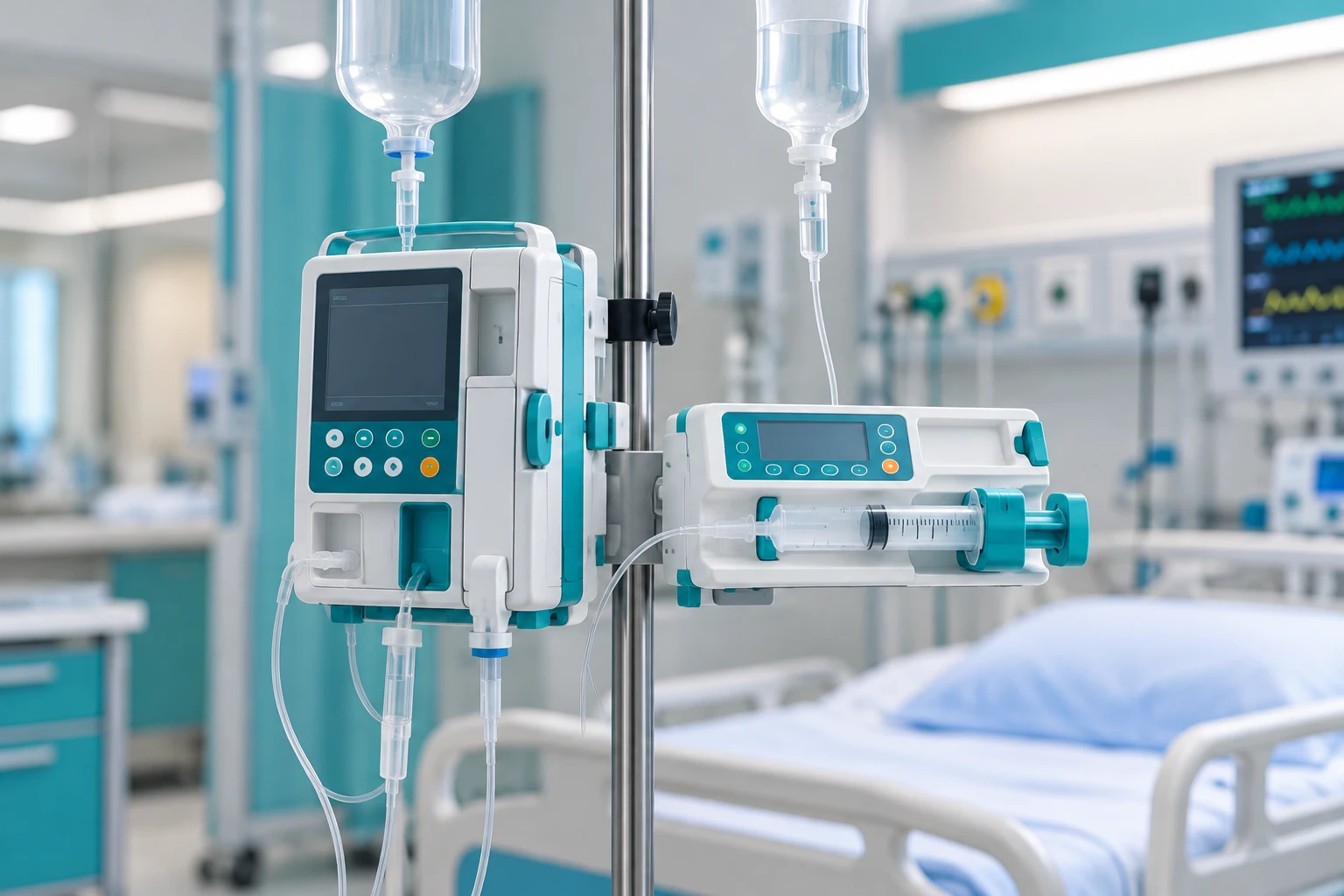
An infusion pump delivers larger fluid volumes, intravenous fluids, blood products, nutrition and most drug infusions, through a flexible IV bag or bottle at rates typically measured in millilitres per hour, while a syringe pump delivers small, precise volumes directly from a syringe, built for drugs that need exact dosing at low flow rates where even a small error matters clinically. Both are infusion devices in the broad sense, but they are built for different volumes, different accuracy requirements and different clinical settings, and buying the wrong one for a department almost always shows up later as either wasted capability or a genuine dosing risk. This guide covers exactly how the two differ, what actually drives price beyond the basic type, and how to decide which one, or which mix of both, your hospital or clinic actually needs.
Key Takeaways
- An infusion pump is built for larger-volume fluids and standard drug infusions delivered through an IV bag, while a syringe pump is built for small-volume, high-precision dosing directly from a syringe.
- Flow rate accuracy is the real technical difference that matters clinically, syringe pumps are engineered for accurate delivery at very low flow rates where infusion pumps are not designed to perform reliably.
- Price depends far more on the number of channels, alarm and safety features, and battery backup than on the basic infusion-versus-syringe distinction itself.
- Most general wards and ICUs need both device types, not one instead of the other, because they cover different parts of the same patient's drug and fluid therapy.
- Buying based on departmental need rather than defaulting to whichever device is cheaper upfront avoids the more expensive mistake of under-equipping a critical care area.
What an Infusion Pump Actually Does
An infusion pump moves fluid from a flexible IV bag or bottle through a dedicated administration set and into the patient at a programmed rate, typically expressed in millilitres per hour. It is the standard device for intravenous fluids, blood and blood products, parenteral nutrition, and the great majority of drug infusions that do not require extremely low-volume precision. Most infusion pumps used in Indian hospitals today are volumetric pumps, meaning they measure and control the actual volume delivered rather than simply regulating drip speed by gravity, which is a meaningful step up in both accuracy and safety compared to a manual gravity drip set.
A modern infusion pump typically includes programmable rate and volume limits, a drug library with built-in dosing safety checks on higher-end models, free-flow protection that prevents an uncontrolled bolus if the set is removed from the pump incorrectly, and occlusion alarms that detect a blocked line before it becomes a clinical problem. These safety features, not the basic ability to push fluid, are what separate a reliable clinical-grade infusion pump from a bare-minimum unit, and they are exactly where buyers most often cut corners to save on upfront price.
What a Syringe Pump Actually Does
A syringe pump holds a prefilled syringe, typically 10ml, 20ml, 30ml or 50ml, and delivers its contents at a precisely controlled, usually much slower rate, often measured in millilitres per hour down to fractions of a millilitre per hour for the most demanding applications. This makes it the right device for high-potency drugs where a small dosing error has an outsized clinical effect: vasopressors, inotropes, sedatives in critical care, insulin infusions, and paediatric and neonatal drug delivery where total volumes are inherently small and margins for error are correspondingly tight.
The mechanical design driving this precision is different from an infusion pump's. A syringe pump uses a motor-driven plunger mechanism that advances at a calibrated rate, which is what allows accurate delivery at flow rates far lower than a volumetric infusion pump is designed or calibrated to handle reliably. Trying to use an infusion pump for a drug that genuinely needs syringe-pump-level precision is a common and avoidable clinical risk, not a matter of preference.
The Real Technical Difference: Why Flow Rate Accuracy Matters
The headline difference buyers usually hear, bigger volumes versus smaller volumes, is true but incomplete. The deeper technical difference is flow rate accuracy at the low end. An infusion pump is engineered and calibrated for the flow rate ranges typical of IV fluids and standard drug infusions, generally from a few millilitres per hour up to several hundred. A syringe pump is engineered specifically for accuracy at much lower rates, often down to 0.1ml/hr or finer increments, because that is the range where high-potency drugs are actually dosed.
This is not a marginal distinction. A vasopressor infusion running at an imprecise rate can swing a patient's blood pressure in a clinically dangerous direction within minutes. An infusion pump pushed to deliver at a flow rate below its designed accuracy range may technically run, but the actual delivered volume per hour can drift from the programmed rate by a margin that matters enormously at that dose, even if the same margin would be clinically irrelevant for a litre of normal saline running over several hours. This is the single most important reason hospitals should not treat the two device types as interchangeable based on availability alone.
Price Comparison: What You Are Actually Paying For
| Feature | Basic Infusion Pump | Advanced Infusion Pump | Basic Syringe Pump | Advanced Syringe Pump |
|---|---|---|---|---|
| Typical use | General ward IV fluids | ICU, drug libraries, multi-channel | Single high-precision drug | ICU, multiple high-potency drugs, networked |
| Flow rate range | Standard IV range | Standard IV range, finer control | Low flow, high precision | Very low flow, finest precision |
| Safety features | Basic occlusion and free-flow alarms | Drug library, dose error reduction, data logging | Occlusion alarm, basic rate limits | Drug library, networked alarms, battery redundancy |
| Typical setting | General wards, OPD procedures | ICU, OT recovery, high-acuity wards | General ward single-drug use | ICU, NICU, cardiac care |
| Relative price position | Entry-level | Mid to premium | Entry-level | Mid to premium |
Price within each category is driven far more by channel count, alarm sophistication, drug library presence, battery backup duration and connectivity for centralised monitoring than by the basic infusion-versus-syringe distinction. A single-channel basic unit of either type sits at the lower end of its category. A multi-channel unit with a built-in drug library, dose error reduction software and networked alarm reporting to a central nursing station sits meaningfully higher, regardless of whether it is technically an infusion pump or a syringe pump. Buyers comparing quotes should match feature sets before comparing price, since two units quoted at very different prices are frequently not actually comparable devices once the specification sheet is read in full.
Which Departments Actually Need Which Device
ICU and critical care
Needs both, almost always. Fluid resuscitation and nutrition run through infusion pumps, while vasopressors, sedatives and other high-potency continuous infusions run through syringe pumps, often several of each per bed in a well-equipped ICU. Our ICU Setup Equipment Checklist covers the full critical care equipment list these pumps sit alongside.
NICU and paediatric wards
Syringe pumps are disproportionately important here because neonatal and paediatric drug doses are small in absolute volume, which makes low-flow-rate accuracy a safety requirement rather than a convenience. A facility running a NICU without adequate syringe pump capacity is taking on real, avoidable dosing risk.
General wards
Primarily infusion pumps for routine IV fluids and standard drug infusions. Syringe pump needs are lower and more occasional, usually for a specific patient on a specific high-potency drug rather than a department-wide requirement.
Operation theatre and recovery
A mix depending on case mix, with syringe pumps becoming more relevant for anaesthesia-related infusions and recovery-area vasopressor support. Our OT Setup Equipment Checklist covers the broader theatre equipment list.
Dialysis and oncology units
Infusion pumps dominate for the larger-volume fluid and drug administration typical of these settings, with syringe pumps playing a smaller supporting role for specific high-potency medications.
Common Buying Mistakes
Buying only infusion pumps because they appear more versatile on paper is the single most common mistake, since it leaves a facility unable to safely deliver the high-potency, low-volume drugs that are routine in any ICU or NICU. The opposite mistake, over-investing in syringe pumps while under-equipping on infusion pump capacity for routine fluids, is less common but does happen, usually in a facility that recently had a critical care scare and over-corrected without a department-wide equipment review.
A second common mistake is treating channel count as the only variable that matters while ignoring drug library presence and dose error reduction features, particularly for a facility planning ICU or NICU expansion where medication error risk is highest. A third is buying a mixed inventory of different brands and models across a department without standardising, which makes staff training, consumables compatibility and maintenance contracts all harder to manage consistently than a more deliberate, standardised procurement approach would.
Consumables and Ongoing Cost: What the Purchase Price Does Not Tell You
Both device types require ongoing consumables, administration sets for infusion pumps and syringes plus extension sets for syringe pumps, and these recurring costs compound significantly over a device's working life in a way the upfront purchase price does not reflect. A facility evaluating total cost of ownership should factor in consumables compatibility, since some pump models require proprietary administration sets at a price premium over generic equivalents, a detail that is easy to miss when comparing two pump quotes purely on the headline device price. Our sister platform H.O.P.E. runs a pooled procurement network for exactly this kind of recurring consumables spend, and its guide on par level inventory for hospitals is worth reading before finalising your pump purchase, since administration set and syringe consumption planning works the same way as any other consumable category.
Maintenance, Calibration and Service Contracts
Both infusion and syringe pumps require periodic calibration checks to confirm flow rate accuracy has not drifted from specification, and this matters more for syringe pumps given how much low-flow-rate precision actually affects patient safety at the doses they are used for. A service contract covering annual calibration, battery replacement and software updates where applicable should be factored into your total cost of ownership from the start, not treated as an afterthought once a unit's accuracy is already in question. Facilities that skip routine calibration checks on the assumption that a pump "seems to be working fine" are taking on a risk that typically surfaces only when a dosing discrepancy is traced back to equipment rather than clinical error, by which point the cost of the oversight is measured in more than money.
Battery Backup and Power Reliability
Given that both pump types are frequently used for continuous, sometimes life-sustaining infusions, battery backup duration is a genuinely important specification, particularly for any facility in an area with less reliable grid power. A pump that fails mid-infusion during a power cut without adequate battery backup is a real clinical risk, not a hypothetical one, and this is a detail worth checking explicitly on the specification sheet rather than assuming all units in a given price range offer comparable backup duration. Advanced units generally offer longer backup windows and clearer low-battery alerting than basic entry-level models, which is part of what the price difference between tiers is actually paying for.
Frequently Asked Questions
Can an infusion pump be used in place of a syringe pump?
Not reliably for drugs requiring low-flow-rate precision. An infusion pump is not calibrated for the very low flow rates a syringe pump handles accurately, and using one in place of the other for a high-potency drug is a genuine dosing risk rather than a simple convenience trade-off.
Do all ICUs need both device types?
Almost universally yes. A well-equipped ICU needs infusion pumps for fluids and standard drug delivery and syringe pumps for high-potency, low-volume drugs, and the two are not substitutes for each other within critical care.
What drives the price difference between a basic and an advanced pump of the same type?
Channel count, drug library presence, dose error reduction software, battery backup duration and networked alarm connectivity drive price within a category far more than the basic infusion-versus-syringe distinction itself.
How many syringe pumps does a typical ICU bed need?
This varies by case mix and hospital protocol, but it is common for a single ICU bed to need more than one syringe pump running simultaneously for different high-potency drugs, which is worth planning for explicitly rather than assuming one unit per bed is sufficient.
Are consumables for infusion and syringe pumps interchangeable?
No, administration sets for infusion pumps and syringes with extension sets for syringe pumps are different consumable categories, and some pump models require proprietary sets at a price premium, which is worth checking before you commit to a specific brand at scale.
Is calibration really necessary if a pump appears to be working normally?
Yes. Flow rate drift is not something that is reliably detectable by observation alone, particularly at the low flow rates syringe pumps operate at, which is exactly why periodic calibration checks are a patient safety requirement, not an optional maintenance step.
Compare verified sellers for both infusion and syringe pumps in one place. Register on HOSPkart to get quotes matched to your department's actual case mix.

Author
Devendra Sharma
Related posts




15-4-2026
Top 20 Lab Equipment for Diagnostic Labs