 Medical Equipment
 Hospital Furniture
 Medical Disposables
 Rehabilitation
 Diagnostic & Labware
 Eyes & ENT
 Critical Care Equipment
 Urology
 Aesthetic & Dermatology Equipment
 Gastroenterology
 OT Equipment
By Hospkart On 15-04-2026 at 5:11 pm
Must-Have Medical Equipment List for Hospitals in 2026
Healthcare is changing rapidly, and having the right medical equipment is vital to providing high-quality patient care. Advanced medical equipment provides hospitals with the ability to diagnose and treat patients, as well as improve the overall efficiency, safety and results of care.
When opening a new hospital or upgrading an existing one, buying the right medical equipment can affect both the performance of your operation and ultimately help you satisfy more patients.
This is a complete guide to the must-have medical equipment for hospitals in 2026, as well as practical suggestions to help you make sound buying decisions concerning equipment.
Why Medical Equipment is Critical for Hospitals
Each hospital is a combination of skilled caregivers and reliable medical equipment. Providers deliver care to patients through emergency treatment or everyday evaluation; therefore, medical equipment is at the core of the patient care delivery process of every healthcare organization.
Key benefits include:
Quicker and more accurate diagnoses and treatment
Improved patient safety & monitoring
More efficient workflow & less manual labor
Improved patient outcomes
When you consider these four items, investing in medical equipment is not an expense; it is a requirement.
Must-Have Medical Equipment List for Hospitals
Here is an essential summary of the main types of medical equipment that a hospital should offer to its patients:
1. Hospital Beds
Hospital beds are one of the most basic yet crucial types of medical equipment. Adjustable beds improve patient comfort and help healthcare providers deliver better care.
Types:
Manual beds
Semi-electric beds
Fully electric beds
2. Patient Monitors
Patient monitors are essential medical equipment used to track vital signs such as heart rate, oxygen levels, and blood pressure.
They are especially important in ICUs and emergency wards.
3. Defibrillators
Defibrillators are an important piece of medical equipment that saves lives during spontaneous cardiac arrests. A defibrillator sends energy through a patient's heart to help it regain a normal heart rhythm during emergencies. When a patient suffers from spontaneous cardiac arrest.
4. Ventilators
Ventilators are another essential piece of medical equipment used when providing support for a patient who cannot breathe independently. They became particularly necessary during the COVID-19 pandemic and continue to remain as one of the most essential pieces of medical equipment in any ICU.
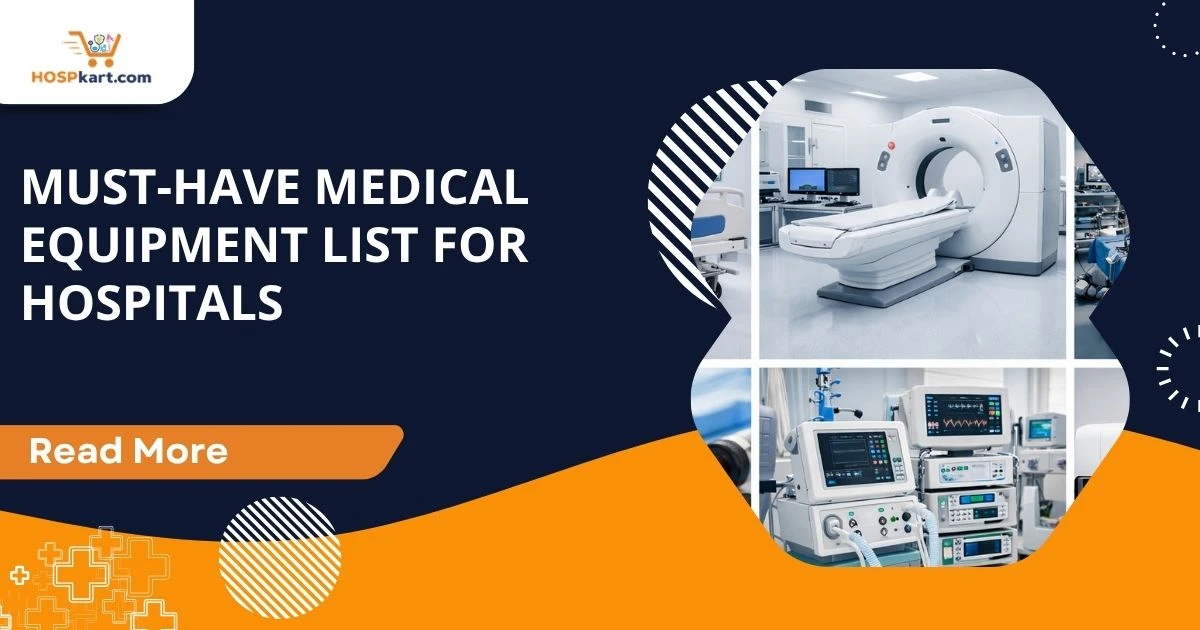
5. Diagnostic Equipment
Hospitals also possess a variety of diagnostic medical equipment used in various departments to identify any present or future diseases.
X-ray machines
MRI scanners
CT scanners
Ultrasound machines
These tools help in the accurate and early detection of diseases.
6. Laboratory Equipment
Laboratory equipment is important for preparing samples and analysing patient specimens. Some common items are blood analysers, microscopes, centrifuges, and biochemistry analysers.
7. Infusion Pumps
Infusion pumps are medical devices used to deliver fluids, medications, and nutrients to patients in very precise amounts. They also ensure accurate dosing and prevent potential overdoses.
8. Sterilization Equipment
Sterilization in a hospital is very important. For example; special sterilisation equipment such as an autoclave will assure that there will be no harmful microorganisms left on a surgical instrument after it has been sterilised. This ensures sanitation for patients and prevents infections.
9. Surgical Instruments
Every hospital should have a complete set of surgical medical equipment. A set of surgical medical equipment may contain different types of medical instruments, including:
Scalpels
Forceps
Scissors
Retractors
These are essential for performing various surgical procedures.
10. Emergency Equipment
Emergency rooms require a lot of specialised emergency medical equipment. These may include:
Stretchers
Oxygen cylinders
Suction machines
Crash carts
These tools are crucial for handling critical situations efficiently.
How to Choose the Right Medical Equipment
There is more to the selection of the appropriate medical equipment than just comparing prices. The following are some important considerations when choosing medical equipment to purchase:
1. Quality & Certification
You should only purchase medical equipment that conforms to international quality standards, such as ISO or CE certification.
2. Reliability
Medical equipment should provide reliable performance and minimize the risk of downtime.
3. Cost vs Value
While price is certainly a consideration, the primary concern should be on acquiring long-term value from your medical equipment purchases, rather than simply a low purchase price.
4. After-Sales Support
Medical equipment is going to need maintenance and servicing; therefore, you should look for suppliers that have a strong after-sales support program.
5. Ease of Use
Medical equipment that is easy to use will allow for less time spent on training and will lead to more efficient operations.
Benefits of Bulk Purchasing Medical Equipment
Most hospitals require large quantities of specific medical equipment, so bulk purchasing of medical equipment will be a cost-efficient strategy for them to pursue.
Advantages include:
Lower unit cost
Increased negotiation power
Consistent supply
Simplified purchasing process
Bulk purchasing is particularly beneficial to multi-specialty hospitals and healthcare chains.
Latest Trends in Medical Equipment (2026)
Healthcare technology continues to develop and become increasingly smarter and more efficient, which impacts today's medical devices.
Key trends include:
AI-powered diagnostics
Portable and wearable devices
Smart patient monitoring systems
Integration with digital health platforms
Automation of hospital workflows
The innovations regarding new types of medical devices will have a major impact on how hospitals do surgery and care for patients.
Challenges in Medical Equipment Procurement
Even with the many advancements related to medical equipment, hospitals still face challenges associated with acquiring new medical equipment. The following are examples of challenges faced by hospitals when acquiring new medical equipment:
Pricing differences between vendors
Limited price transparency
Delayed shipments and deliveries
Reliance on multiple suppliers
Overall, all of these challenges add to the overall cost of procurement and create inefficiencies in processing.
Smarter Way to Procure Medical Equipment
Today, new digital platforms are changing how hospitals buy medical equipment.
HOSPkart is one of these platforms, which helps hospitals procure medical supplies more efficiently by:
Connecting hospitals with verified suppliers
Putting hospitals and amending (Please recheck this, I don’t think it makes sense)
Providing “volume-based” discounts
Delivering a central location for all hospital needs
Overall, this will reduce the complexity of purchasing and improve efficiency.
Final Thoughts
Selecting the right medical devices is very crucial for hospitals. Reliable medical devices will have an effect on all aspects of the healthcare system, from patient care to efficient healthcare operations.
Besides the right tool selection, hospitals also need to concentrate on how they obtain those medical devices. Acquiring medical devices via the use of smarter procurement methods (e.g., bulk purchasing) and reliable platforms offers hospitals improved service levels and lower costs.
As we enter the year 2026, the combination of sophisticated medical devices and efficient systems will give direction to the future of healthcare.
FAQs
Q1. What is the most essential medical equipment in hospitals?
Ans- Hospital beds, ventilators, monitors, and diagnostic equipment.
Q2. How can hospitals reduce medical equipment costs?
Ans- Bulk purchasing, shopping around, and using an online platform such as HOSPkart.
Q3. Why is medical equipment important?
Ans- Medical equipment will allow clinicians to accurately diagnose a patient, treat their health problem, and deliver the best outcome possible for them.

Michael is a lover, fighter and hater. He loves to travel, has an app called ‘The Travaluk’. He has travelled over 30 countries so far and dreams to visit every one of them.
Related posts